
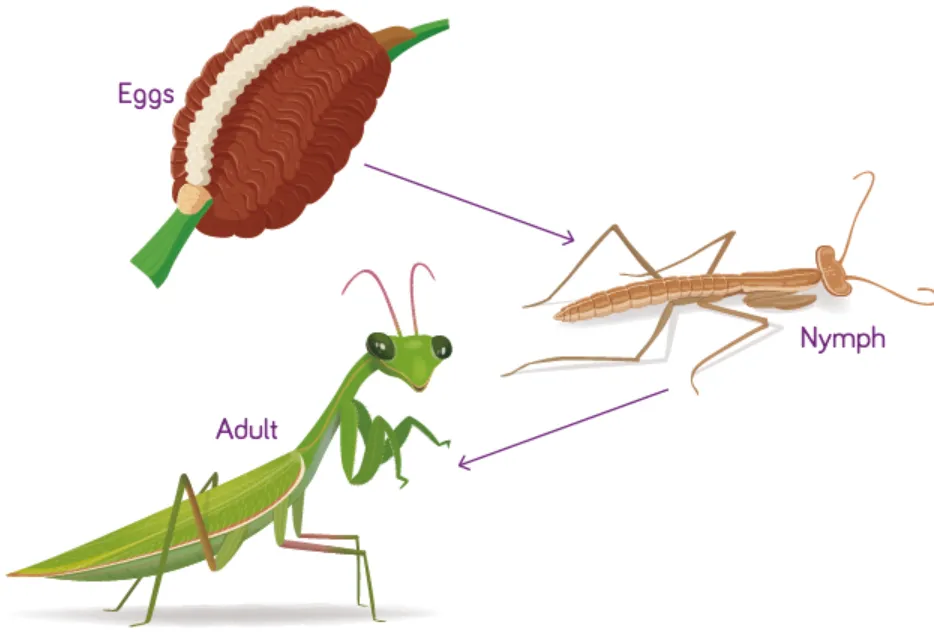
The mantis life cycle is one of the most fascinating stories in the insect world. A mantis begins as an egg sealed inside a tough foam case, grows into a tiny hunting nymph, molts again and again, and finally becomes an adult predator with folded front legs that look almost like hands in prayer. This is why many people call it the praying mantis.
Scientifically, mantises belong to the insect order Mantodea. Modern taxonomic databases recognize more than 2,400 valid mantis species. At the same time, general entomology references describe them as insects with triangular heads, long bodies, and powerful raptorial front legs built for grabbing prey.
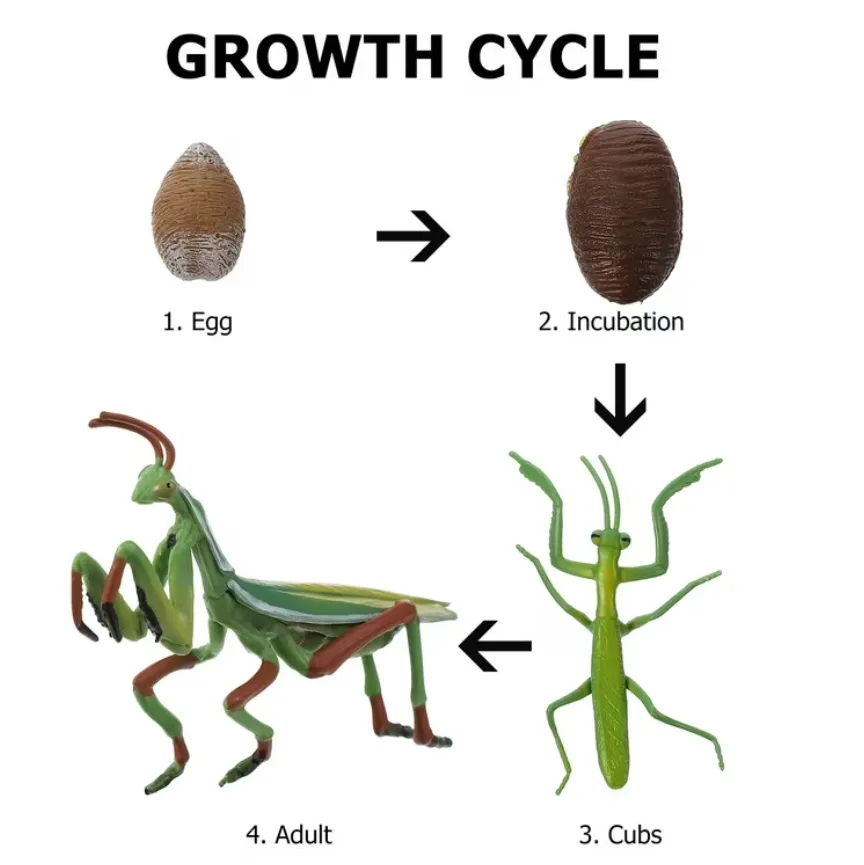
Unlike butterflies, mantises do not pass through a caterpillar or pupa stage. Their growth follows an incomplete metamorphosis, meaning the main stages are egg, nymph, and adult. The young nymphs already look like tiny adults, but they are wingless and must shed their outer skin many times before maturity.
Q: What are the three stages of the mantis’ life cycle?
A: The three stages are egg, nymph, and adult.
Q: How long does a mantis live?
A: Many mantises live only a few months as adults, though the full life cycle can take close to a year in temperate climates because eggs may overwinter inside the ootheca.
Q: What is an ootheca?
A: An ootheca is the protective egg case made by a female mantis. It starts as soft foam, then hardens to protect the eggs from weather and predators.
Quick Life Cycle Table
| Life Stage | What Happens | Survival Purpose |
| Egg | The female lays eggs inside a foamy case called an ootheca. | The hard case protects eggs from cold, drying, and some predators. |
| Nymph | Young mantises hatch looking like tiny adults, but they have no fully developed wings. | Nymphs begin hunting small insects quickly and grow through several molts. |
| Molting Stage | The nymph sheds its outer skin many times as its body grows. | Molting allows the mantis to grow and slowly develop adult body parts. |
| Adult | The mantis becomes sexually mature, often with developed wings, depending on species and sex. | Adults hunt, mate, lay eggs, and continue the next generation. |
A mantid egg case can contain many eggs. In one studied mantid species, an ootheca may contain more than 200 eggs, and nymphs undergo simple metamorphosis from egg to nymph to adult.
The History of Their Scientific Naming
The name mantis has a long history. In Greek, the word Mantodea derives from the word mantis, which means “prophet” or “seer.” The insect’s folded front legs led people to imagine a praying pose, which gave rise to the common name “praying mantis.”
The best-known scientific name is Mantis religiosa. This species was originally described by Carl Linnaeus in 1758 as Gryllus religiosus, and later classification placed it under the genus Mantis.
The word religiosa reflects the old human habit of connecting the insect’s posture with prayer or religious devotion. Britannica also notes that names in several languages connect the mantis with piety, prayer, or spiritual imagery.
Important naming points:
• Mantodea is the insect order.
• Mantis religiosa is one famous species, not the name of every mantis.
• Praying mantis is a common name based on posture.
• Entomologists often use Mantid for members of the order Mantodea.
• Many species have descriptive common names, such as orchid mantis, dead leaf mantis, and grass mantid.
This naming history shows how science, language, and human observation all shaped the way we talk about these insects today.
Their Evolution And Their Origin
Mantises did not appear as random garden insects. They are part of a much larger evolutionary story inside the insect group Dictyoptera, which also includes cockroaches and termites. Modern studies use fossils, body traits, and molecular data to understand when mantises and their relatives separated from older insect lineages. A major phylogenetic study sampled hundreds of praying mantises, cockroaches, and termites to build a time-based picture of Dictyoptera evolution.
The main evolutionary breakthrough of mantises is their raptorial forelegs. These front legs are not ordinary walking legs. They are enlarged, spined, and folded in a way that lets the mantis strike and hold prey. This single-body design turned the mantis into a patient ambush predator.
Their triangular head, flexible neck, large compound eyes, and camouflage also helped them survive. Many species blend with leaves, bark, flowers, grass, or dry twigs. This makes them harder for predators to see and easier for them to surprise prey.
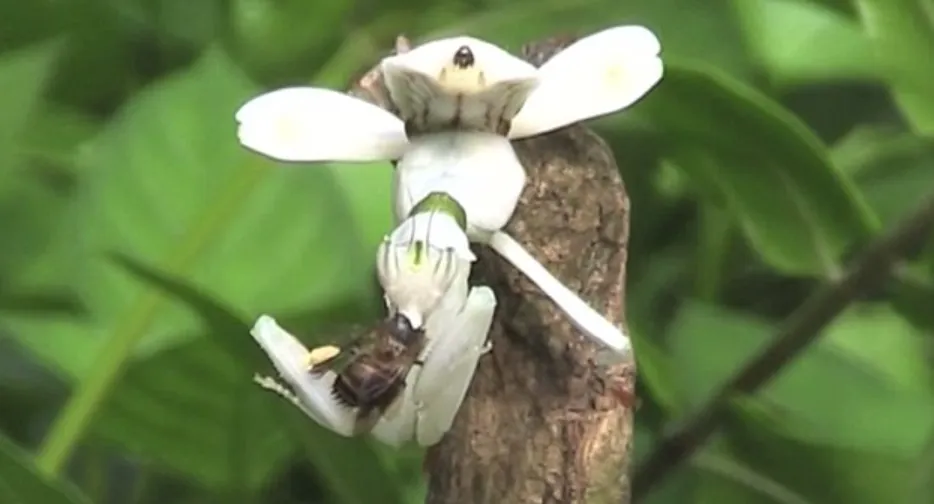
The orchid mantis is a strong example of evolutionary specialization. Modern genomic research has shown that the orchid mantis developed flower-like colors and body shapes linked to camouflage and prey attraction. Its white and pink appearance, broad abdomen, and petal-like leg structures help it resemble flowers in tropical habitats.
This evolution did not happen overnight. It was shaped by natural selection over long periods of time. Mantises that hid better, caught prey more efficiently, and reproduced successfully passed their traits to future generations.
Their main food and its collection process
The mantis is a carnivorous insect predator. Its main food is living prey, especially insects and other small arthropods. Depending on species and size, a mantis may eat flies, moths, crickets, grasshoppers, beetles, caterpillars, mosquitoes, bees, butterflies, and even other mantises.
Large mantises can sometimes capture small vertebrates, but this is not their normal daily diet. Most of their feeding role in nature involves insect hunting.
Their food collection process is slow, quiet, and highly efficient.
• Waiting silently
A mantis often sits still on leaves, stems, flowers, fences, or tree bark. It does not waste energy chasing every insect.
• Using camouflage
Green species hide among fresh leaves. Brown species blend into dry grass or bark. Flower mimics, such as the orchid mantis, use their body shape and color to blend into their surroundings.
• Tracking movement
The mantis uses large compound eyes and head movement to judge distance. Its vision helps it strike only when prey comes close enough.
• Striking with raptorial legs
When prey enters range, the mantis shoots out its folded front legs. The sharp spines grip the prey tightly.
• Eating with chewing mouthparts
After capture, the mantis uses strong mouthparts to eat the prey. It usually begins feeding while the prey is still held in its front legs.
• Choosing prey by size and opportunity
A mantis is not a picky hunter. It usually takes whatever suitable moving prey is available.
This feeding style is why mantises are often seen as helpful garden predators. Still, they are general predators, meaning they can eat pest and beneficial insects alike. Gardeners should value them as part of a balanced ecosystem, not as a perfect pest control tool. Beneficial insect guidance also notes that predator insects can help reduce pest populations when the habitat supports them.
Their life cycle and ability to survive in nature
Egg Stage inside the Ootheca
The mantis life cycle begins when the female creates an ootheca. This egg case starts as a soft foam produced from her abdomen. It soon hardens into a protective shell.
In many temperate regions, eggs remain in the ootheca throughout winter. This protects the next generation during cold months when adult mantises usually cannot survive.
Nymph Stage
When the eggs hatch, tiny nymphs come out. They look like small adult mantises, but they are wingless and delicate. Many spread out quickly because young mantises may eat one another if food is limited.
The nymph stage is dangerous. Birds, spiders, lizards, frogs, ants, and larger insects may eat them. Their best defense is to hide, move carefully, and grow fast.
Molting Stage
A mantis must molt several times. During molting, it sheds its old outer skin. This is risky because the body is soft for a short time after each molt.
If the humidity, food, or perch position is poor, a mantis may fail during molting. In nature, only a portion of nymphs survive to adulthood.
Adult Stage
The adult mantis is stronger, better armed, and ready to reproduce. Some adults can fly, especially males in many species. Females are often heavier because they need energy for egg production.
Adult survival depends on camouflage, food, temperature, and safe mating opportunities. The life cycle succeeds when the adult female lays a new ootheca and restarts the cycle.
Their Reproductive Process and raising their children
Mantis reproduction is direct, risky, and strongly tied to survival energy. Adult males usually search for females when conditions are right. In temperate climates, this often happens near the end of the warm season.
Important points about their reproductive process:
• Male approach
The male approaches carefully. Female mantises are powerful predators so that a careless male may be treated as prey.
• Mating
The male climbs onto the female and transfers sperm. After mating, the female can fertilize eggs and produce one or more oothecae, depending on the species and condition.
• Sexual cannibalism
Female mantises are famous for sometimes eating males during or after mating. This does not happen in every mating event. Studies on sexual cannibalism show that when it occurs, nutrients from the male can contribute to female reproduction and egg production.
• Ootheca formation
The female lays eggs in a foamy material that hardens into a protective case. In some mantids, one ootheca can contain over 200 eggs.
• No active parenting in most species
Most mantis species do not raise their young after hatching. The mother protects them mainly by choosing a safe place for the ootheca.
• Nymph independence
Newly hatched nymphs must survive alone. They hunt tiny insects, hide from predators, and molt as they grow.
So, mantises do not raise children like birds or mammals. Their parenting strategy is mostly about producing protected eggs and providing the young a safe start.
The importance of them in this Ecosystem
Natural Pest Control
Mantises help control insect populations. They eat many plant-feeding insects, including some pests that damage gardens, crops, and wild plants. This makes them part of nature’s pest-balancing system.
They should not be treated as a complete replacement for all pest management, because they are general predators. They may also eat pollinators and other helpful insects. Still, their presence usually means the habitat has enough insect life to support predators.
Food Web Balance
Mantises are predators, but they are also prey. Birds, bats, reptiles, amphibians, spiders, and larger insects may eat them. This places mantises in the middle of the food web.
They move energy from small insects upward to larger animals. Without predators like mantises, some insect populations could grow too quickly.
Biodiversity Indicator
A place with mantises often has plant cover, insects, shelter, and seasonal balance. They need vegetation for hiding, egg laying, and hunting.
A garden with no insects, no native plants, and heavy pesticide use is less likely to support healthy mantis populations.
Pollinator Habitat Connection
Many beneficial insects thrive in areas with flowers, shelter, field margins, and less chemical disturbance. Extension guidance on beneficial insects highlights the value of food and shelter for insects that help reduce pests and support healthier gardens or farms.
Evolutionary Value
Mantises also matter because they show how life adapts. Their camouflage, vision, hunting posture, and life cycle make them excellent examples of natural selection in action.
Important Things That You Need To Know
When researching mantis life cycle, people often search related terms such as mantis, orchid mantis, celestial mantis, mantis shrimp punch, peacock mantis shrimp, lotus mantis, and rawrr mantis. These terms are useful for search intent, but not all of them mean the same thing.
The word mantis usually refers to insects in the order Mantodea. These are the true praying mantises that grow from egg to nymph to adult. The orchid mantis is a real mantis species famous for its flower-like camouflage. Research on the orchid mantis shows that its body color and petal-like structures are linked to advanced camouflage and evolutionary adaptation.
But mantis shrimp punch and peacock mantis shrimp refer to marine crustaceans, not praying mantis insects. The peacock mantis shrimp is famous for its extremely fast striking appendage. Duke research notes that high-speed imaging found that peacock mantis shrimp mouthparts can reach speeds ofspeeds of 12 to 23 meters per second in water and create cavitation bubbles.
The terms “lotus mantis” and “celestial mantis” require careful handling. Viral posts about a lotus mantis have been flagged as fabricated or AI-generated, not a verified scientific insect species. Celestial Mantis is more often connected with pop culture or viral content than accepted mantis taxonomy. Marvel, for example, connects the character Mantis to the phrase “Celestial Madonna,” not to a biological insect group.
Finally, Rawrr Mantis is a brand and product name connected with electric dirt bikes, not an insect.
So, for an accurate article, use these LSI keywords carefully. Keep the main focus on the real mantis life cycle, and treat unrelated terms as search language or clarification points.
What to do to protect them in nature and save the system for the future
Protecting mantises means protecting the small habitats that allow insects, plants, and predators to live together. A mantis cannot survive in an empty, overcleaned, chemical-heavy landscape.
• Plant native flowers and shrubs
Native plants attract many insects. Some become prey for mantises, while others support pollinators and the wider food web.
• Reduce pesticide use
Broad pesticide spraying can kill mantises, their prey, and other beneficial insects. Use chemicals only when necessary and follow local safety guidelines.
• Keep small wild corners
Leave some grasses, stems, shrubs, or leaf litter in safe areas. Mantises need places to hide, hunt, and attach oothecae.
• Do not destroy oothecae unnecessarily
If you find a mantis egg case on a twig or fence, leave it alone when possible. It may contain the next generation.
• Avoid buying random egg cases online
Some commercial egg cases may contain non native species. Releasing non native insects can disturb local ecosystems.
• Support mixed garden life
A healthy garden should have predators, pollinators, decomposers, and plant-feeding insects in balance.
• Teach children to observe, not harm
Mantises are excellent insects for nature learning. Watching them builds respect for small wildlife.
• Protect field margins and natural strips
Farm edges, ditches, and uncultivated strips can support both predators and pollinators. This can help reduce pest pressure while preserving biodiversity.
Frequently Asked Questions (FAQs)
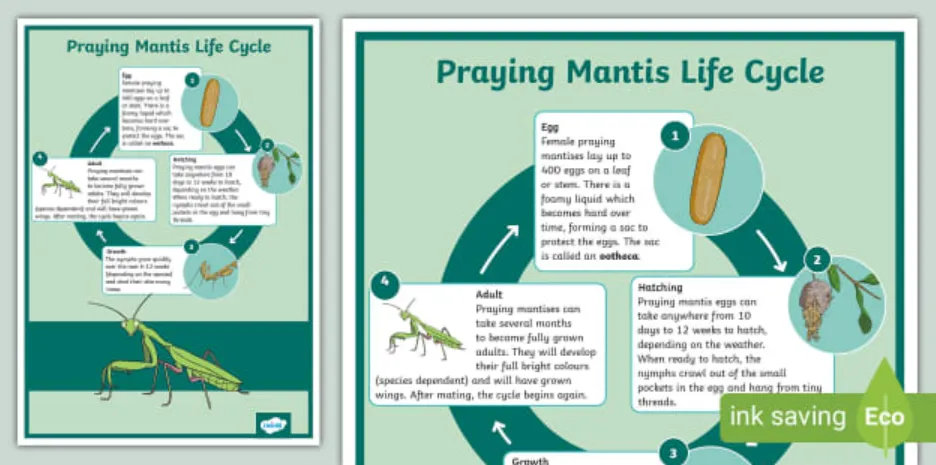
Q: What is the mantis’ life cycle?
A: The mantis life cycle has three main stages: egg, nymph, and adult. This is called incomplete metamorphosis because there is no pupa stage.
Q: What is the egg case of a mantis called?
A: The egg case is called an ootheca. It is made from foam that hardens into a protective case.
Q: How many eggs can a mantis lay?
A: It depends on the species. Some oothecae may contain dozens of eggs, while certain mantids can produce egg cases with more than 200 eggs.
Q: Do baby mantises look like adult mantises?
A: Yes. Baby mantises, called nymphs, look like tiny adults, but they are usually wingless and much smaller.
Q: What do mantis nymphs eat?
A: They eat small insects such as tiny flies, aphids, and other soft-bodied prey. If food is scarce, they may even eat other young mantises.
Q: Do all female mantises eat males after mating?
A: No. Sexual cannibalism can happen, but it is not guaranteed in every species or every mating event.
Q: Is the orchid mantis real?
A: Yes. The orchid mantis is real and is known for its flower-like camouflage. It is one of the most famous examples of mantis mimicry.
Q: Is a mantis shrimp a praying mantis?
A: No. A mantis shrimp is a marine crustacean. It is not part of the insect order Mantodea, even though it has the word mantis in its name.
Conclusion
The mantis life cycle is a powerful example of survival through design, patience, and adaptation. From the hidden ootheca to the tiny nymph and finally the adult hunter, every stage has a clear purpose. The egg case protects life before it begins. The nymph stage builds strength through hunting and molting. The adult stage completes the cycle through feeding, mating, and egg laying.
Mantises are not just strange-looking insects. They are important predators, food for other animals, and signs of a living ecosystem. Their folded legs, sharp vision, camouflage, and careful movements show how deeply nature shapes every detail of a creature’s life.
To protect them, we need more than curiosity. We need native plants, fewer chemicals, safe wild corners, and respect for small life. When mantises survive, the gardens, fields, and forests around them become healthier too.
Also Read: termite life cycle