
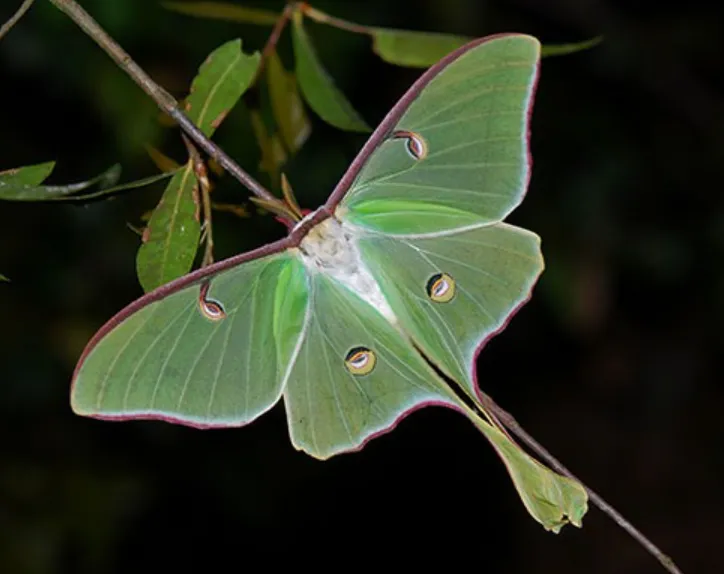
The luna moth life cycle is one of the most beautiful examples of complete transformation in nature. This pale green moth, known scientifically as Actias luna, belongs to the Saturniidae family, also called giant silk moths. It is native to North America and is famous for its soft green wings, long tail-like hindwings, and short adult lifespan. The adult luna moth usually lives only about a week because it does not eat after emerging from its cocoon. Its main purpose at that stage is to find a mate and reproduce.
What makes this moth so interesting is that most of its real work happens before it becomes an adult. The luna moth caterpillar eats leaves, grows through several stages, creates a luna moth cocoon, and then changes into the winged adult that people admire at night. The cycle is short, delicate, and strongly connected to forest health.
Q: How long is the luna moth’s lifespan?
A: The adult luna moth lifespan is usually around one week, but the full life cycle can last several weeks or longer if the pupa overwinters.
Q: What does a luna moth caterpillar eat?
A: A luna moth caterpillar feeds on leaves from host trees such as hickory, walnut, sweetgum, persimmon, willow, oak, birch, and sumac.
Q: Is there a purple luna moth?
A: A true natural purple luna moth is not the normal form. Real luna moths are usually pale green or lime green, while purple versions are mostly seen in art, edited photos, tattoos, or fantasy-style drawings.
Quick Life Cycle Table
| Life Stage | What Happens | Average Time | Main Survival Need |
| Egg | Females lay eggs on the underside of host plant leaves | About 7 to 13 days | Safe leaf surface and warm conditions |
| Larva | The luna moth caterpillar eats leaves and molts several times | About 4 to 7 weeks | Fresh host leaves and camouflage |
| Pupa | A caterpillar spins a silk cocoon, often using a leaf | About 2 to 3 weeks, or through winter | Leaf litter, cover, and protection from the weather |
| Adult Moth | Adult emerges, expands wings, mates, and lays eggs | About 7 days | Finding a mate and avoiding predators |
The timing of the luna moth life cycle varies by region. Northern populations often complete one generation per year, while warmer southern areas may support two or three generations in one year.
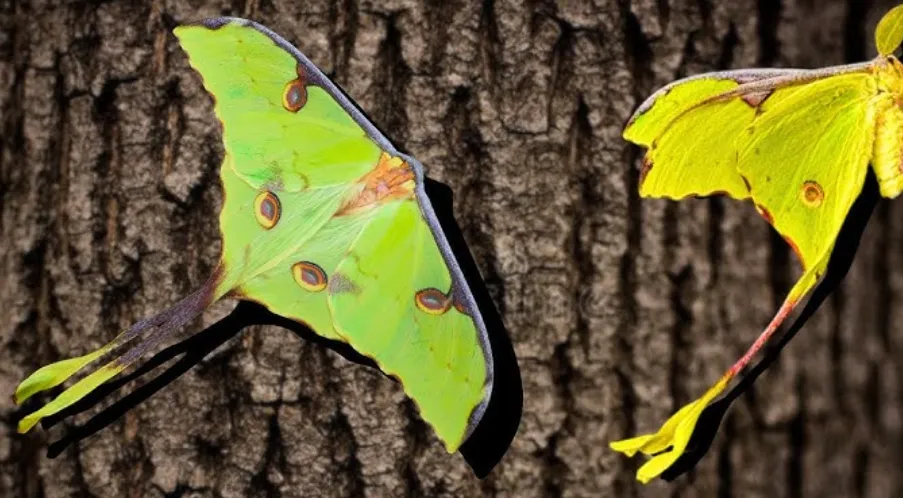
The History of Their Scientific Naming
The scientific naming of the luna moth has an interesting history because it connects natural science with ancient mythology.
• The luna moth was first reported in early North American insect literature by James Petiver in 1700. He described it using an older Latin-style name that referred to its bright appearance and feather-like tail.
• In 1758, Carl Linnaeus gave the species a formal scientific name in the tenth edition of Systema Naturae. It was first placed under the name Phalaena luna.
• Over time, the classification changed, and today the accepted scientific name is Actias luna.
• The word luna comes from Luna, the Roman moon goddess. This name fits the moth well because of its pale, night-flying beauty and moon-like markings.
• The family name Saturniidae is linked with the eyespots found in many giant silk moths. These circular patterns reminded early naturalists of the planet Saturn and its rings.
This naming history helps explain why the luna moth is often called the American moon moth. The name is not random. It reflects the moth’s night behavior, soft color, and almost dreamlike appearance.
Their Evolution And Their Origin
The luna moth is a North American member of the giant silk moth family. Its origin is tied to deciduous forests, where broadleaf trees provide food for caterpillars and shelter for cocoons. The species is mainly found in forested areas of eastern North America, from parts of Canada down through much of the eastern United States.
The evolutionary success of Actias luna comes from several strong adaptations. The caterpillar stage is built for feeding, growth, and camouflage. Its green body blends with the leaves, helping it hide from birds and other predators. When threatened, older larvae may use defensive behaviors such as making warning sounds or releasing unpleasant fluids.
The adult stage shows a different kind of adaptation. Adult luna moths do not feed, so they save energy for flying and mating. Their long hindwing tails are especially important. Research shows these spinning tails can confuse bat echolocation and draw attacks away from the moth’s body. This gives the moth a better chance of surviving long enough to reproduce.
Their evolution is also connected to host plants. The luna moth caterpillar can feed on several kinds of trees, including hickory, walnut, sweetgum, birch, persimmon, and sumac. This flexible feeding habit helps the species survive across different forest habitats.
In simple terms, the luna moth life cycle evolved around one main goal: use the caterpillar stage to store energy, the cocoon stage to transform safely, and the adult stage to reproduce quickly before time runs out.
Important Things That You Need To Know
Many people search for the luna moth life cycle because the moth looks rare, magical, and meaningful. But to understand it properly, you also need to know the related ideas people often ask about.
The luna moth is not only beautiful; it is also fascinating. It is a real forest insect with a short adult life and a very active caterpillar stage. The adult moth does not eat. So, when people talk about the luna moth lifespan, they should separate the adult lifespan from the full egg-to-adult cycle.
The luna moth caterpillar is in the feeding stage. It eats leaves from specific host trees and stores the energy that the adult will later use for flight and mating. Without healthy host trees, the life cycle cannot continue.
The luna moth cocoon is also important. It is usually made with silk and often wrapped in leaves. In colder regions, this cocoon may protect the pupa through winter until the adult emerges in spring.
A purple luna moth is not the normal natural color. Real luna moths are usually pale green. Purple versions are more common in fantasy art, body art, edited photography, or symbolic designs.
The phrase “luna moth tattoo meaning” is popular because many people associate the moth with transformation, rebirth, intuition, night beauty, and a short but meaningful life. A luna moth drawing often highlights the wings, eyespots, and long tails because these are the features that make the species instantly recognizable.
Their main food and its collection process
The main food of a luna moth depends on its life stage. Adult luna moths do not eat because their mouthparts are not functional. Their stored energy comes from the food they consumed as caterpillars. That means the luna moth caterpillar is the true feeding stage of the species.
Common host plants include:
• Hickory
• Walnut
• Sweetgum
• Persimmon
• Willow
• Oak
• Birch
• Sumac
These trees provide the fresh leaves needed for growth. The female moth carefully selects host plants because newborn caterpillars cannot travel far after hatching. If the eggs are placed on a suitable tree, the tiny larvae can begin eating almost immediately.
The collection process is natural and simple. The caterpillar uses its mouthparts to chew leaf edges, taking in plant tissue that contains water, fiber, and nutrients. As it grows, it molts several times, shedding its old skin and entering a larger stage.
A healthy caterpillar must eat enough to build fat reserves. These reserves become extremely important later because the adult moth does not feed. In this way, every leaf eaten during the larval stage supports future flight, mating, egg production, and survival.
Although luna moth caterpillars can be large, they usually do not appear in numbers high enough to damage trees seriously. Texas A&M Forest Service notes that they are not considered pests and generally do not cause significant damage to host plants.
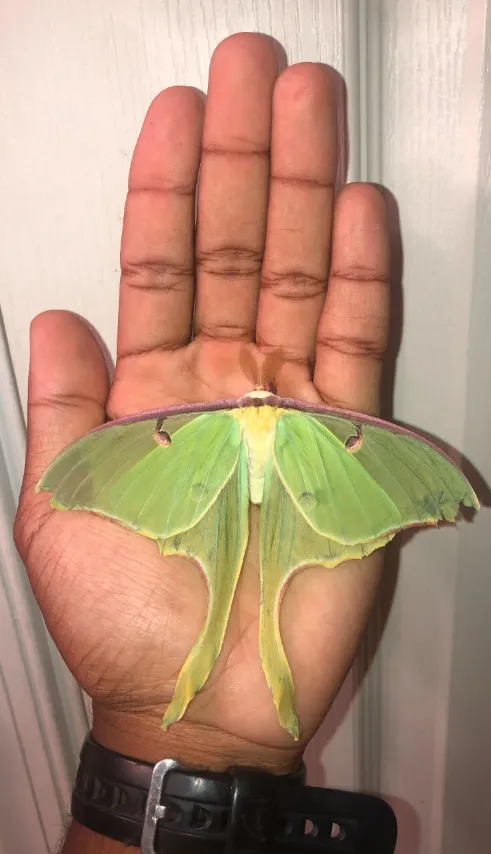
Their life cycle and ability to survive in nature
Egg Stage
The luna moth life cycle begins when a female lays eggs on the underside of host plant leaves. These eggs are small, protected by their placement, and close to the food source the caterpillars will need after hatching.
This stage is vulnerable to weather, predators, and parasites. Still, laying many eggs increases the chance that some will survive.
Caterpillar Stage
After hatching, the luna moth caterpillar begins feeding almost right away. This is the main growth stage. The caterpillar eats leaves, molts, and increases in size until it is ready to pupate.
Its green color helps it blend into the leaves. Some larvae also use defensive behavior when disturbed, which can discourage predators.
Cocoon Stage
When fully grown, the caterpillar moves toward the ground and spins a luna moth cocoon with silk. It may wrap the cocoon inside a leaf, which helps hide it among leaf litter.
This stage is a survival bridge between the feeding caterpillar and the adult moth. In colder regions, the pupa may remain inside the cocoon through winter.
Adult Stage
The adult moth emerges with its wings soft and folded. It must hang quietly while the wings expand and harden. After that, its short life is focused on reproduction.
The adult survives by flying at night, using camouflage, and relying on its long tails to help misdirect bat attacks.
Their Reproductive Process and raising their children
The reproductive process of the luna moth is short but highly specialized. Adult moths live only long enough to mate and produce the next generation.
• Female scent signals
Female luna moths release pheromones at night. These chemical signals help males find them from a distance.
• Male antennae
Male luna moths have large, feathery antennae. These antennae are very sensitive and help detect airborne female pheromones.
• Mating at night
Mating usually happens during the adult stage, soon after emergence. Since adults do not feed, time is limited.
• Egg laying
After mating, the female lays eggs on the underside of suitable host leaves. This placement protects the eggs and gives the young caterpillars immediate access to food.
• No parental care after egg laying
Luna moths do not raise their young the way birds or mammals do. The mother’s main care is choosing a good host plant. Once the eggs are laid, the young must survive independently.
• High egg number strategy
Females may lay many eggs because only a portion will survive predators, weather, disease, and other natural threats.
This process may seem simple, but it is effective. The entire reproductive strategy depends on timing, good host plant selection, and the adult moth’s ability to find a mate quickly.
The importance of them in this Ecosystem
A Food Source For Wildlife
The luna moth plays an important role in the food web. Birds, bats, spiders, small mammals, and predatory insects may feed on eggs, caterpillars, pupae, or adults.
Even though this sounds harsh, it supports the balance of forest life. Luna moths help move plant energy into the wider Ecosystem.
A Sign Of Healthy Habitat
Seeing luna moths can be a good sign that suitable host trees and natural leaf litter are present. Their life cycle needs trees, clean habitat, low chemical pressure, and safe places for cocoons.
A forest or garden that supports luna moths often supports many other insects, too.
Support For Biodiversity
The luna moth caterpillar feeds on native and common broadleaf trees without usually becoming a pest. This makes it part of a balanced herbivore community.
Different insects feeding on different plants create food for many other animals. This supports biodiversity from the ground layer to the tree canopy.
Night Ecology And Natural Balance
Adult luna moths are active at night. While they are not major pollinators because they do not feed, they are still part of the nighttime Ecosystem.
Their relationship with bats is especially important. The moth’s tail adaptation shows how predator and prey can shape each other over time.
Educational And Cultural Value
Luna moths also matter because they inspire interest in nature. Their beauty helps people care about insects, forests, and conservation. A single luna moth sighting can make someone more curious about native wildlife.
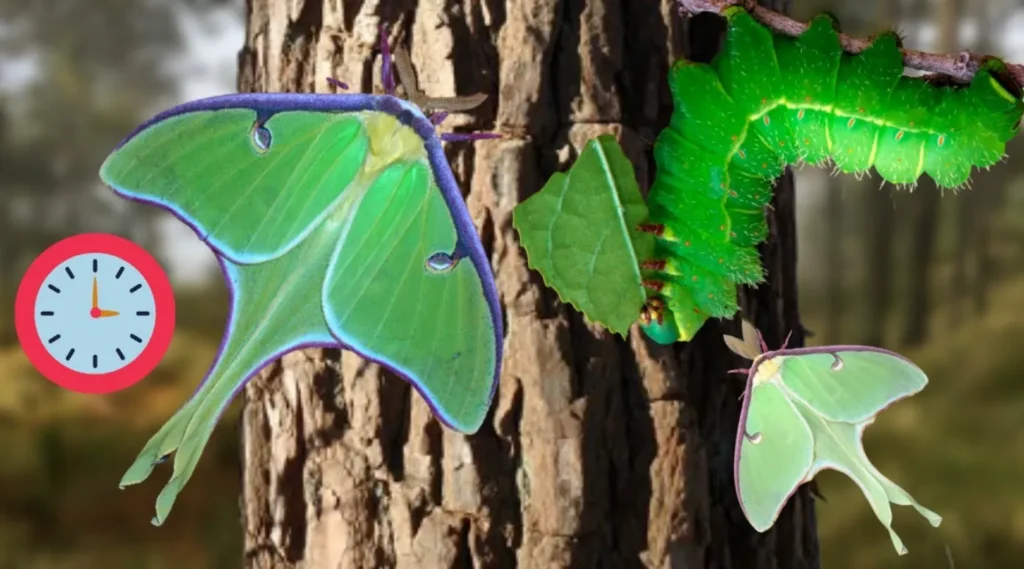
What to do to protect them in nature and save the system for the future
Protecting the luna moth life cycle means protecting every stage: egg, caterpillar, cocoon, and adult. Small choices in gardens, yards, and forest edges can help.
• Plant native host trees such as hickory, walnut, sweetgum, birch, persimmon, willow, oak, and sumac where suitable.
• Avoid unnecessary pesticide use, especially broad insect-killing sprays that can harm caterpillars and other beneficial insects.
• Keep some natural leaf litter under trees because the luna moth cocoon may be hidden among fallen leaves.
• Reduce bright outdoor lights at night. Strong lights can confuse moths, interrupt mating, and make them easier for predators to find.
• Use motion sensor lights instead of leaving porch lights on all night.
• Protect local woodlands, forest edges, and native plant areas.
• Do not remove every wild corner from a garden. A slightly natural area can provide shelter for insects.
• Avoid collecting adult luna moths from the wild just for decoration.
• Teach children that caterpillars are part of a bigger life cycle and should not be harmed.
• Support native plant gardening because it helps not only luna moths but also birds, bees, butterflies, and many other species.
NatureServe lists Actias luna as globally secure, but local declines can still happen when habitat is removed, lighting increases, or host plants disappear.
Frequently Asked Questions (FAQs)
Q: What are the four stages of the luna moth life cycle?
A: The four stages are egg, larva, pupa, and adult moth. This is called complete metamorphosis.
Q: How long does a luna moth live?
A: The adult luna moth lifespan is usually about one week. The full life cycle is longer because the egg, caterpillar, and cocoon stages happen before adulthood.
Q: What does a luna moth caterpillar eat?
A: A luna moth caterpillar eats leaves from host trees such as hickory, walnut, sweetgum, persimmon, willow, oak, birch, and sumac.
Q: Do adult luna moths eat?
A: No. Adult luna moths do not eat because their mouthparts are not functional. They depend on energy stored during the caterpillar stage.
Q: Where is the luna moth cocoon found?
A: A luna moth cocoon is often found in leaf litter or wrapped in a fallen leaf near the ground.
Q: Is a purple luna moth real?
A: A natural purple luna moth is not the normal form of the species. The real moth is usually pale green or lime green. Purple versions are usually artistic or symbolic.
Q: What is the luna moth tattoo meaning?
A: The luna moth tattoo meaning often includes transformation, rebirth, spiritual growth, intuition, night energy, and the beauty of a short life.
Q: Why are luna moth drawings so popular?
A: A luna moth drawing is popular because the moth has a very balanced and graceful shape, with soft wings, eyespots, and long tails that look beautiful in art.
Conclusion
The luna moth life cycle is a powerful story of growth, change, survival, and renewal. From a tiny egg on a leaf to a hungry luna moth caterpillar, then a hidden luna moth cocoon, and finally a pale green adult moth, every stage has a clear purpose.
The adult moth may live only a short time, but its life is not wasted. It carries the energy gathered during the caterpillar stage and uses it to continue the next generation. This makes the luna moth’s lifespan one of the best examples of how nature values timing, adaptation, and balance.
Protecting luna moths means protecting host trees, leaf litter, nights, and healthy forests. When we care for these quiet night insects, we also care for the wider Ecosystem that depends on them. The luna moth reminds us that even a short life can leave a lasting mark.
Also Read: fishes life cycle