
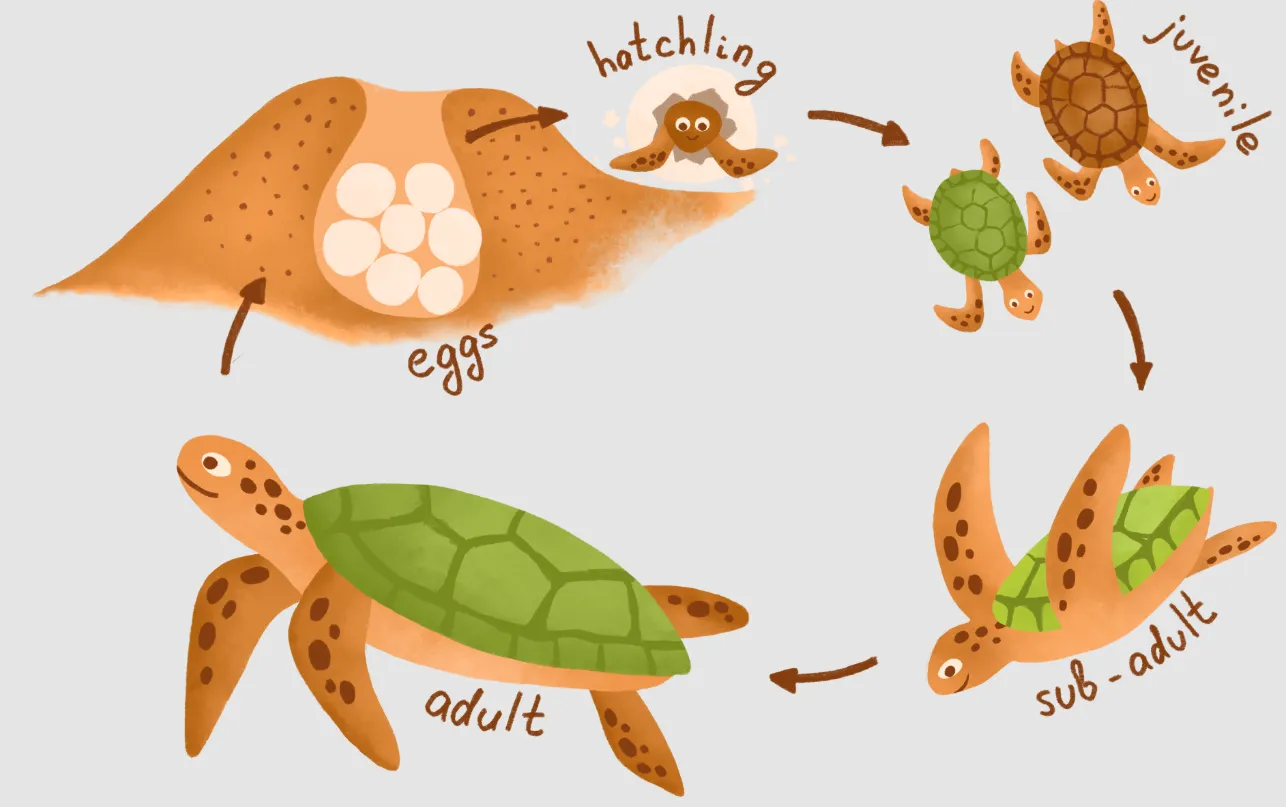
The life cycle of a sea turtle is one of the most fascinating journeys in the marine world. A sea turtle begins life inside an egg buried under warm beach sand, breaks out as a tiny hatchling, rushes toward the ocean, spends years growing in open water, and later returns as an adult to feeding and nesting areas. Most sea turtles spend nearly all their lives in the ocean, but females must come onto sandy beaches to lay eggs.
There are seven living species of sea turtles: green sea turtle, loggerhead sea turtle, leatherback sea turtle, hawksbill sea turtle, olive ridley, Kemp’s ridley, and flatback turtle. They live in tropical and subtropical oceans, migrate long distances, and play an important role in maintaining balance in marine ecosystems. WWF notes that sea turtles are highly migratory and spend most of their lives in the ocean, while NOAA describes their life cycle as a series of stages from hatchling to adult.
Q: How many stages are in the life cycle of a sea turtle?
A: The main stages are egg, hatchling, juvenile, and adult.
Q: Where do sea turtles lay eggs?
A: Female sea turtles lay eggs in nests dug into sandy beaches, often near the area where they hatched.
Q: How long can sea turtles live?
A: Many sea turtles can live 40 to 60 years or more, and some individuals may live longer depending on species and conditions.
Quick Life Cycle Table
| Stage | Where It Happens | What Happens | Key Risk |
| Egg | Sandy beach nest | A female lays eggs in a deep chamber | Flooding, predators, heat |
| Hatchling | Beach to ocean | Baby turtles crawl to the sea | Birds, crabs, lights, fish |
| Juvenile | Open ocean and coastal waters | Young turtles grow and feed | Plastic, fishing gear, predators |
| Adult | Feeding grounds and nesting beaches | Adults migrate, mate, and reproduce | Bycatch, habitat loss, and climate change |
The History Of Their Scientific Naming, Evolution, and Their Origin
Scientific Naming of Sea Turtles
Sea turtles belong to the reptile order Testudines. Each species has its own scientific name. For example, the green sea turtle is Chelonia mydas, the loggerhead sea turtle is Caretta caretta, the hawksbill sea turtle is Eretmochelys imbricata, and the leatherback sea turtle is Dermochelys coriacea. Scientific names help researchers identify species clearly across different languages and regions.
Evolutionary Background
Sea turtles are ancient marine reptiles with a long evolutionary history. Their ancestors were land-based turtles that gradually adapted to life in the sea. Over millions of years, their legs changed into powerful flippers, their bodies became streamlined, and their shells became suited for swimming.
Origin and Global Spread
Modern sea turtles are found worldwide in oceans, especially in warm tropical and subtropical waters. Although they feed at sea, their life cycle remains closely connected to beaches because females must return to land to nest. This link between ocean and shore makes sea turtles highly vulnerable to both marine and coastal threats.
Their Reproductive Process, Giving Birth And Rising Their Children
Mating and Migration
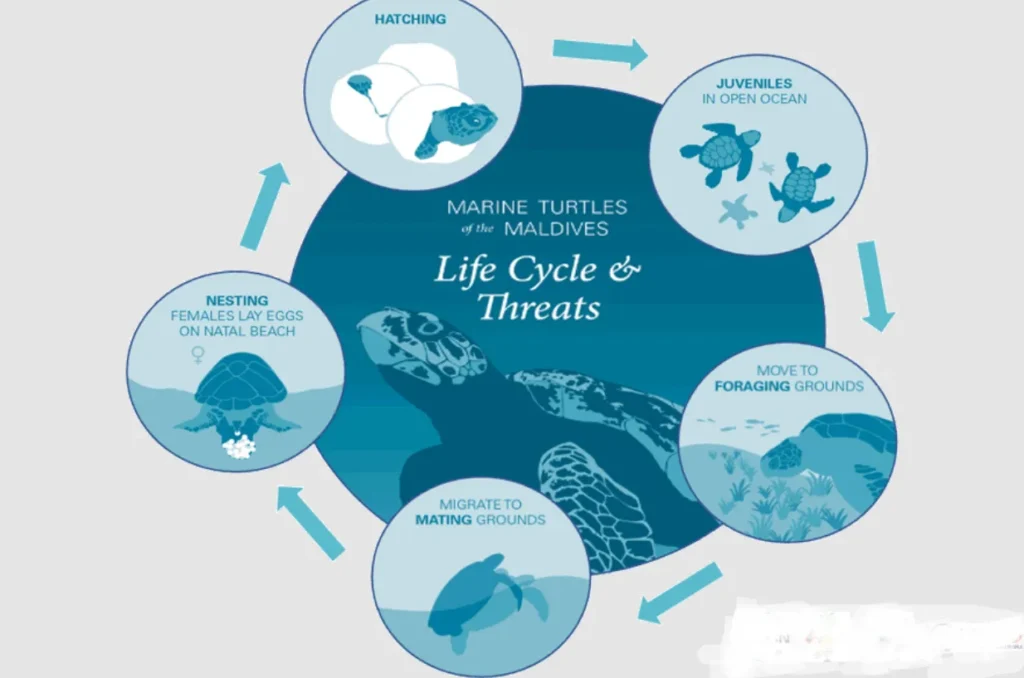
Adult sea turtles usually migrate from feeding areas to breeding areas. Many females return to the same region, and sometimes the same beach, where they were born. This behavior is called natal homing. NOAA reports that adult loggerhead turtles may migrate hundreds to thousands of miles between feeding grounds and nesting beaches.
Nesting on Beaches
After mating, a female sea turtle crawls onto a sandy beach, usually at night. She digs a nest chamber with her rear flippers and lays a clutch of soft, round eggs. Many nests contain 80 to 120 eggs, although the exact number depends on the species and the female’s size.
Incubation and Hatching
The eggs incubate under sand for about two months. In many sea turtles, nest temperature helps determine the sex of hatchlings: warmer sand tends to produce more females, while cooler sand tends to produce more males. NOAA describes this temperature-dependent sex determination in sea turtles.
No Parental Care
Sea turtles do not raise their young like mammals or birds. After laying eggs, the mother covers the nest with sand and returns to the ocean. Hatchlings must dig out, crawl to the sea, and survive on instinct. Their “childhood” is dangerous, and only a small number survive to adulthood.
Important Things That You Need To Know
When learning about the life cycle of sea turtles, it is useful to understand related sea turtle types and popular search terms. A sea turtle is not one single animal but a group of marine reptiles with different sizes, diets, habitats, and conservation needs.
The green sea turtle is famous for its mostly plant-based adult diet, especially seagrass and algae. This makes it very important for healthy seagrass ecosystems. In 2025, IUCN reported that the global status of the green sea turtle improved from Endangered to Least Concern after decades of conservation action, although some subpopulations still face serious threats.
The leatherback sea turtle is the largest and is very different from hard-shelled species because it has a flexible, leathery shell. It mainly eats jellyfish and can travel huge distances across oceans. The hawksbill sea turtle is known for its narrow beak and its strong association with coral reefs, where it feeds heavily on sponges. NOAA notes that hawksbills are found in warm Atlantic, Pacific, and Indian Ocean waters and feed mainly on reef sponges.
The loggerhead sea turtle has a large head and powerful jaws, which help it crush hard-shelled prey such as crabs and mollusks. Popular terms like sea turtle drawing, sea turtle tattoo, and even leatherback sea turtle bite show that people are interested in sea turtles not only as wildlife but also as art, culture, and ocean symbols.
Stages of the Life Cycle of the Sea Turtle
Stage 1: Egg Stage
The life cycle begins when an adult female lays eggs in a sandy beach nest. She uses her flippers to dig a chamber, deposits the eggs, covers them carefully, and returns to the sea. The eggs remain hidden under the sand for about 6 to 8 weeks, depending on temperature, moisture, and species.
This stage is delicate because eggs can be destroyed by flooding, beach erosion, predators, or human disturbance. Climate change also matters because hotter sand can affect hatchling sex ratios.
Stage 2: Hatchling Stage
When the eggs hatch, baby sea turtles work together to climb out of the nest. Most hatchlings emerge at night when temperatures are cooler and predator risk is lower. They move toward the brightest natural horizon, which is usually moonlight or starlight reflecting on the ocean.
Artificial lights from roads, hotels, and beach houses can confuse them. Instead of crawling toward the sea, they may move inland, where they can die from dehydration, vehicles, or predators.
Stage 3: Juvenile Stage
After reaching the ocean, hatchlings enter an early swimming period and move into offshore habitats. Young turtles may spend years in the open ocean, sometimes using floating seaweed mats for shelter and food. This early period is often called the lost years because scientists historically knew little about where young turtles went.
As they grow, many juveniles shift into coastal feeding areas. NOAA explains that green turtle juveniles eventually leave the open ocean habitat and move to shallow coastal foraging grounds.
Stage 4: Adult Stage
Adult sea turtles feed, migrate, mate, and reproduce. Females return to nesting beaches during breeding seasons, while males usually remain at sea. Adults may travel long distances between foraging areas and nesting beaches.
The adult stage is important for population survival because sea turtles take many years to mature. If too many adults are killed by fishing gear, hunting, boat strikes, or pollution, population recovery becomes slow.
Their Main Diet, Food Sources, and Collection Process Explained
Sea turtle diets vary strongly by species and life stage. Hatchlings and young juveniles often eat small floating organisms, tiny crustaceans, fish eggs, jellyfish, and material found around seaweed mats. As they mature, their diet becomes more specialized.
The green sea turtle is mostly herbivorous as an adult. It feeds on seagrass, seaweed, and algae. This grazing helps keep seagrass beds healthy, much like mowing a lawn encourages new growth. National Geographic notes that adult green sea turtles eat mainly seaweed and seagrass.
The hawksbill sea turtle feeds mainly on sponges from coral reefs. Its narrow, beak-like mouth helps it reach into reef cracks. The loggerhead sea turtle eats hard-shelled animals such as crabs, conchs, clams, and other mollusks. Its strong jaws are adapted for crushing.
The leatherback sea turtle mostly eats soft-bodied animals, especially jellyfish. This makes leatherbacks important in controlling jellyfish populations.
Sea turtles do not “collect” food like humans. They forage by swimming through feeding grounds, using sight, smell, and learned habitat patterns. Some graze slowly over seagrass beds, some search reefs, and others follow jellyfish-rich ocean currents.
How Long Does A Sea Turtle Live
The lifespan of a sea turtle varies by species, habitat, food availability, and human pressure. Because they live in the wild ocean and travel long distances, exact ages are difficult to determine.
Common lifespan information includes:
- Many sea turtles live 40 to 60 years or more. The Florida Fish and Wildlife Conservation Commission gives this general range for sea turtles.
- Some species may live longer than 60 years, especially when they survive early life and avoid major threats.
- Sea turtles grow slowly. Many species take decades to reach sexual maturity. The Olive Ridley Project notes that most sea turtles take around 20 to 30 years to mature, and some may take longer depending on species and conditions.
- Hawksbill turtles are estimated to live about 50 to 60 years, although the exact life expectancy remains uncertain. NOAA also notes that hawksbills may reach maturity between 20 and 35 years.
- Loggerhead turtles may spend their first 7 to 15 years in the open ocean before moving to nearshore coastal areas, where they continue growing for another decade or more before maturity.
- A long lifespan does not mean easy survival. Most danger occurs early. Eggs and hatchlings face predators, heat, flooding, and disorientation. Juveniles and adults face fishing nets, hooks, plastic, boat strikes, and habitat loss.
- Slow maturity makes conservation difficult. If a nesting female dies, it may take decades for another turtle to replace her reproductive role.
In simple terms, sea turtles are long-lived animals, but they need safe beaches, clean oceans, and protected migration routes to complete their full natural life cycle.
Sea Turtle Lifespan in the Wild vs. in Captivity
Lifespan in the Wild
In the wild, sea turtles can live for several decades. Many reach 40 to 60 years or more, but survival depends on species, predator pressure, disease, food, nesting success, and human threats. Wild sea turtles also migrate across international waters, which makes protection complicated.
Lifespan in Captivity
Sea turtles are not normal pets and should not be kept privately. In professional rescue centers, aquariums, or rehabilitation facilities, injured turtles may receive medical care, safe food, and protection from predators. However, captivity is usually for rescue, rehabilitation, research, or education.
Which Is Better?
For healthy sea turtles, the wild is the proper place. Captivity can help injured or sick turtles recover, but it cannot replace the natural ocean environment. A sea turtle’s full life cycle depends on migration, natural feeding grounds, mating areas, and nesting beaches.
Importance of Sea Turtles in this Ecosystem
Maintaining Seagrass Beds
Green sea turtles graze on seagrass. This helps prevent overgrowth and encourages healthier, more productive seagrass beds. Seagrass habitats support fish, shellfish, and many small marine animals.
Supporting Coral Reefs
Hawksbill sea turtles feed on sponges, which can compete with corals for space. By eating sponges, hawksbills help maintain the balance of coral reefs. Healthy reefs provide shelter and nursery areas for many marine species.
Controlling Jellyfish
Leatherback sea turtles eat jellyfish. This helps balance jellyfish populations in the ocean. When jellyfish numbers grow too much, they can affect fish larvae and disrupt marine food webs.
Moving Nutrients
Sea turtle eggs and hatchlings also transfer nutrients from the ocean to beaches. Unhatched eggs and eggshells enrich beach ecosystems, supporting plants and small animals. This connection shows that sea turtles link marine and coastal systems.
What to Do to Protect Them in Nature and Save the System for the Future
Protect Nesting Beaches
- Keep nesting beaches clean, quiet, and dark.
- Avoid disturbing nests, tracks, or nesting females.
- Support beach patrol and nest monitoring programs.
Reduce Plastic Pollution
- Avoid single-use plastics whenever possible.
- Dispose of fishing line, bags, bottles, and packaging properly.
- Join beach cleanups to remove plastic before it reaches the sea.
Use Turtle-Friendly Fishing Practices
- Support fisheries that use Turtle Excluder Devices and safer gear.
- Bycatch is one of the biggest human threats to sea turtles worldwide. WWF reports that Turtle Excluder Devices can greatly reduce marine turtle bycatch in shrimp trawls.
Control Beach Lighting
- Turn off unnecessary beach lights during nesting season.
- Use turtle-safe lighting where coastal lighting is needed.
- Close curtains in beachfront buildings at night.
Fight Climate Change and Habitat Loss
- Protect dunes, reefs, mangroves, and seagrass beds.
- Reduce carbon emissions where possible.
- Support conservation policies that protect coastal habitats.
Fun & Interesting Facts About Sea Turtle
- Sea turtles are ancient reptiles that have survived for millions of years.
- A female sea turtle may return to the same region where she hatched to lay her eggs.
- Leatherback sea turtles are the largest sea turtles and have a flexible, leathery shell instead of a hard shell.
- Green sea turtles are not named for the color of their shell, but for the greenish color of their body fat, linked to their plant-based diet.
- Hawksbill sea turtles have a sharp, bird-like beak that helps them feed on reef sponges.
- Sea turtle hatchlings usually emerge at night to reduce heat stress and predator risk.
- Artificial lights can confuse hatchlings and lead them away from the ocean.
- Sea turtles cannot pull their heads and flippers fully inside their shells like many land turtles.
- Some sea turtles migrate thousands of miles between feeding and nesting areas.
- A sea turtle’s sex can be influenced by the temperature of the sand during egg incubation.
Frequently Asked Questions (FAQs)
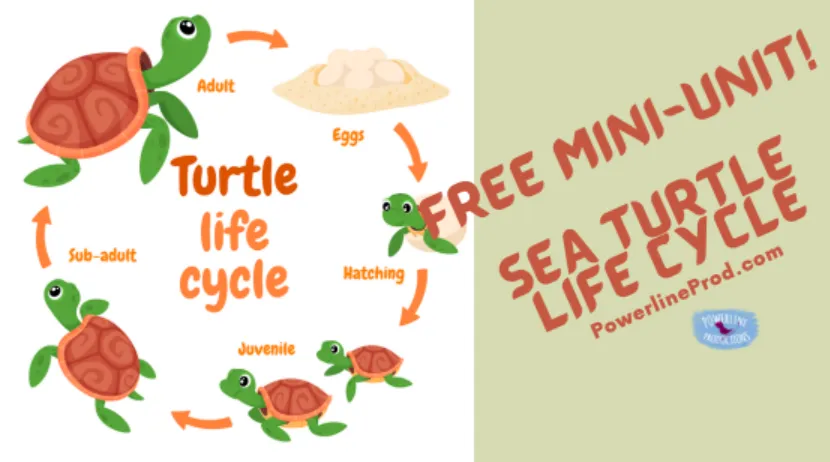
Q: What is the life cycle of a sea turtle?
A: The life cycle of a sea turtle includes four main stages: egg, hatchling, juvenile, and adult. It begins on a sandy beach and continues through years of ocean growth and migration.
Q: How long does it take sea turtle eggs to hatch?
A: Sea turtle eggs usually hatch after about two months, although timing can vary with temperature, moisture, nest depth, and species.
Q: Do sea turtles take care of their babies?
A: No. After laying and covering the eggs, the female returns to the ocean. Hatchlings survive by instinct from the moment they leave the nest.
Q: What do sea turtles eat?
A: Diet depends on species. Green sea turtles eat seagrass and algae, hawksbill sea turtles eat sponges, loggerheads eat hard-shelled prey, and leatherbacks eat jellyfish.
Q: How long do sea turtles live?
A: Many sea turtles live 40 to 60 years or more, but the exact lifespan varies by species and survival conditions.
Q: Why are sea turtles important?
A: Sea turtles help maintain seagrass beds, coral reefs, jellyfish balance, and nutrient movement between ocean and beach ecosystems.
Q: Are sea turtles endangered?
A: Conservation status differs by species and population. Some sea turtle species remain threatened, while the green sea turtle was globally reclassified by the IUCN from Endangered to Least Concern in 2025 following long-term conservation efforts.
Conclusion
The life cycle of the sea turtle is a remarkable story of survival, migration, and the connection between land and sea. From a soft-shelled egg hidden in warm sand to a powerful adult crossing oceans, every stage is full of risk and purpose. Sea turtles support healthy seagrass beds, coral reefs, beach ecosystems, and marine food webs.
However, their future depends on human choices. Plastic pollution, bycatch, coastal development, artificial lighting, climate change, and illegal trade can disrupt their life cycles before they reach adulthood. Protecting nesting beaches, reducing plastic, supporting safer fishing, and restoring marine habitats are practical ways to help them survive.
Sea turtles have lived on Earth for millions of years. With strong conservation and responsible ocean use, future generations can still witness these ancient marine reptiles nesting, swimming, and keeping ocean ecosystems alive.
Also Read: life cycle of a turtle