
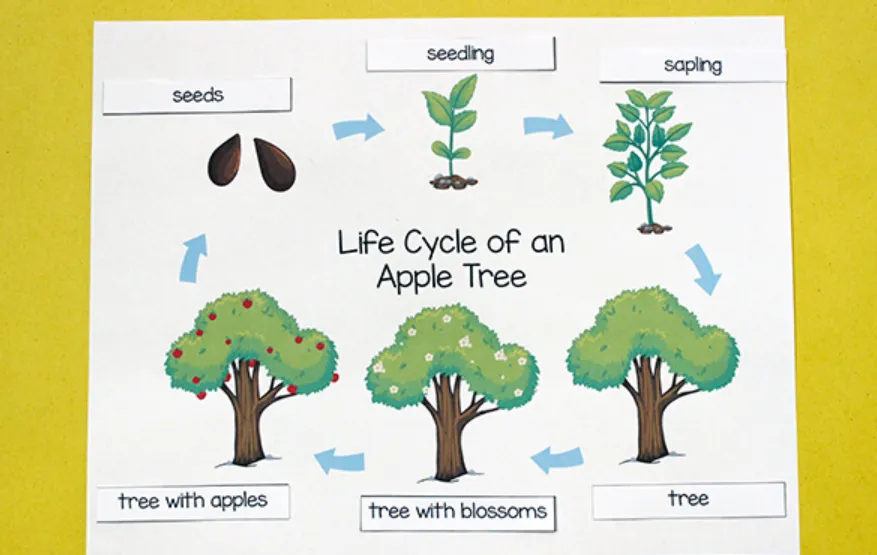
The life cycle of an apple tree is the natural journey of an apple tree from a tiny seed to a mature, fruit-producing tree. Scientifically, the cultivated apple is known as Malus domestica, a deciduous fruit tree from the Rosaceae family. Apple trees grow best in temperate climates, where they receive enough winter chilling, spring warmth, sunlight, water, and nutrients.
An apple tree does not produce fruit immediately after germination. It first develops roots, stems, leaves, and branches. After several years, it reaches the flowering stage, where apple blossoms appear. These flowers must usually be cross-pollinated by insects such as bees before fruit can form. Apple trees commonly require another compatible apple variety nearby for successful fruit production.
In home gardens, dwarf apple trees may start fruiting within 2–3 years, while standard apple trees may take up to 8 years before producing fruit. Apple trees need at least 8 hours of sunlight daily during the growing season and regular pruning to stay healthy and productive.
Q: How many stages are in the life cycle of an apple tree?
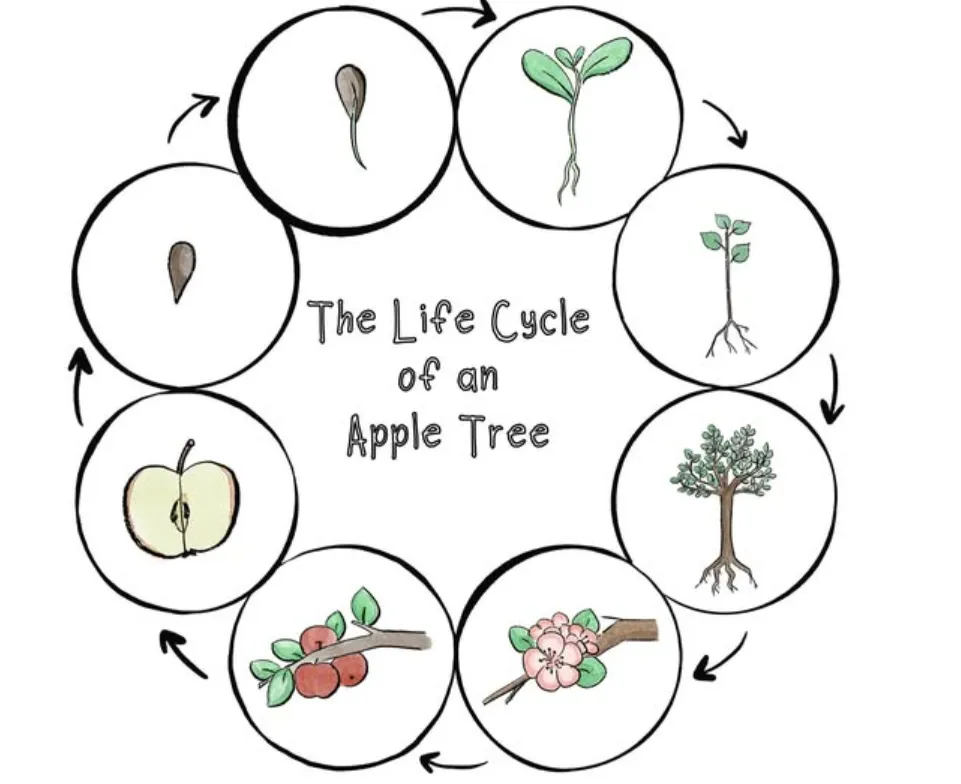
A: The main stages are seed, seedling, young/sapling tree, mature flowering tree, and fruit-bearing adult tree.
Q: How long does it take an apple tree to produce fruit?
A: A dwarf apple tree may produce fruit in 2–3 years, while a standard apple tree may take up to 8 years.
Q: Do apple trees need another tree to make apples?
A: Usually yes. Most apple trees need cross-pollination from another compatible apple variety or crabapple tree to produce a good fruit crop.
Important Things That You Need To Know
The apple tree is more than just a fruit-producing plant. It is a long-living, seasonal, pollinator-dependent tree with strong ecological and agricultural value. A healthy apple tree passes through yearly cycles of dormancy, bud break, flowering, fruit development, harvest, and leaf fall.
One important thing to know is that most cultivated apple trees are not grown directly from seed for commercial fruit quality. They are commonly produced by grafting, where the fruiting variety, called the scion, is joined to a rootstock that controls tree size, disease tolerance, and time to fruiting. The University of Minnesota Extension explains that when you buy an apple tree, you are often buying a plant made of two genetically different parts: the scion and the rootstock.
Another key point is sunlight. A productive apple tree needs strong sun exposure because leaves use sunlight to create energy through photosynthesis. Without sufficient sunlight, the tree may produce weak branches, fewer flowers, and smaller or lower-quality fruit.
Apple trees also depend heavily on insects. Bees and flies transfer pollen between apple flowers, allowing fruit to set. This makes the apple tree’s life cycle closely linked to pollinator health. Protecting bees, avoiding unnecessary pesticides during bloom, and planting compatible varieties nearby can improve fruit production.
Quick Life Cycle Table
| Stage | What Happens | Approximate Time |
| Seed | An apple seed contains the embryo of a new tree | Starts after seed maturity |
| Germination | A seed absorbs water and produces a root and a shoot | Weeks to months, depending on conditions |
| Seedling | A small plant grows leaves and roots | First year |
| Sapling / Young Tree | Stronger stems, branches, and root systems develop | 1–3+ years |
| Mature Tree | A tree produces flowers and fruit after pollination | Dwarf: 2–3 years; standard: up to 8 years |
| Aging Tree | Fruit production may decline with age | Depends on type and care |
The History of Their Scientific Naming, Evolution, and Origin
Scientific Name and Classification
The cultivated apple tree is scientifically called Malus domestica. Kew’s Plants of the World Online lists Malus domestica (Suckow) Borkh. as an accepted species name and identifies it as a tree native to the temperate biome.
The word Malus refers to the apple genus, while domestica reflects its long history as a cultivated plant. Apple trees belong to the Rosaceae family, the same broad family that includes roses, pears, cherries, plums, and many other fruiting plants.
Origin of the Apple Tree
The modern domesticated apple is believed to have originated from the wild apple Malus sieversii, which is native to Central Asia. Kew notes that the modern apple was cultivated from this wild ancestor, while Britannica states that domestication likely began in Central Asia’s Tien Shan mountains thousands of years ago.
Evolution and Human Selection
Over time, humans selected apple trees with better fruit size, sweetness, color, storage quality, and flavor. As apples moved along trade routes such as the Silk Road, they hybridized with other wild apple relatives. This long process created the wide diversity of apple varieties known today.
Their Reproductive Process, Giving Birth And Rising Their Children
Flowering Stage
An apple tree does not “give birth” like an animal. Instead, it reproduces through flowers, pollination, fruit formation, and seed development. In spring, apple trees produce clusters of white to pale pink flowers known as apple blossoms. Kew describes apple flowers as five-petalled blossoms that appear in spring as leaves begin to grow.
Pollination Process
For fruit to develop, pollen must move from one apple flower to another compatible flower. Bees, flies, and other insects usually do this. Apple trees are insect-pollinated, and wide varieties need pollen from a different apple variety or crabapple to produce a good crop.
Fruit and Seed Development
After successful pollination, the fertilized flower begins forming an apple fruit. Inside the apple, seeds develop within the core. Each seed contains genetic material that can grow into a new tree under suitable conditions.
However, apple trees grown from seed may not produce fruit identical to the parent tree. This is why orchards usually use grafted trees to preserve desirable fruit quality.
“Raising Their Children”
Apple trees support the next generation by producing fruit around the seeds. The sweet fruit attracts animals, birds, and humans. In natural conditions, animals may eat fallen apples and disperse seeds away from the parent tree.
This seed dispersal helps new apple trees grow in different places, although cultivated orchards mainly rely on human planting and grafting.
Stages of the Life Cycle of an Apple Tree
1. Seed and Germination Stage
The life cycle begins inside an apple seed. Each seed contains a tiny embryo that can grow into a new apple tree. When the seed receives moisture, oxygen, and suitable temperature conditions, it begins germination.
The first root grows downward into the soil, anchoring the young plant and absorbing water. Then a shoot grows upward toward light. This early stage is fragile because the seedling depends on proper soil moisture and protection from pests.
2. Seedling Stage
After germination, the young apple seedling develops small leaves. These leaves begin photosynthesis, allowing the plant to produce energy from sunlight.
During this stage, root growth is very important. A strong root system helps the seedling absorb water and minerals. If the seedling grows in poor soil, heavy shade, or drought, it may become weak or die before reaching the sapling stage.
3. Sapling or Young Tree Stage
The sapling stage is when the apple tree grows taller, forms stronger branches, and develops a more stable trunk. In cultivated orchards, this stage is often shaped by pruning and training.
Young apple trees need full sun, enough spacing, water during dry periods, and protection from disease. The University of Minnesota Extension recommends full sun and notes that trees planted too close together may suffer from shading and reduced fruit quality.
4. Mature Flowering and Fruiting Stage
A mature apple tree produces flowers, receives pollen, and develops fruit. Dwarf trees may fruit earlier, while standard trees usually take longer.
At this stage, the tree follows a yearly rhythm: winter dormancy, spring bud break, flowering, fruit set, summer fruit growth, autumn harvest, and winter rest. With good care, the mature stage can last many years.
Their main diet, food sources, and collection process are explained
Apple trees do not eat food like animals. Their “diet” comes from sunlight, water, carbon dioxide, and soil nutrients.
Main Food Source: Photosynthesis
The leaves of an apple tree collect sunlight and use it to make sugars through photosynthesis. These sugars power root, leaf, and flower growth, fruit development, and winter storage.
Water Collection
Apple trees collect water through their roots. Water carries dissolved minerals from the soil into the plant. During dry periods, apple trees need deep watering, especially when young or during fruit development. The University of Minnesota Extension recommends thorough watering during dry spells and notes that trees ideally receive about one inch of water per week from May through October.
Nutrient Collection
Roots absorb important nutrients such as nitrogen, phosphorus, potassium, calcium, magnesium, and trace minerals. These nutrients help with leaf color, flower production, fruit quality, and disease resistance.
Soil and Sunlight Requirements
Apple trees prefer fertile, well-drained soil. Kew notes that apple cultivars are mainly adapted to temperate climates and prefer fertile, cool, and damp soil, suitable for both sandy and loamy conditions.
In simple terms, an apple tree “feeds” itself by using sunlight above ground and collecting water and nutrients below ground.
How long does the life cycle of an Apple Tree Live
The lifespan of an apple tree depends on variety, rootstock, climate, soil, disease pressure, pruning, water availability, and care. Not all apple trees live the same length of time.
- Dwarf apple trees usually live shorter lives than full-size trees. They are popular in home gardens because they stay small and can produce fruit earlier.
- Semi-dwarf apple trees usually live longer than dwarf trees but may not live as long as standard trees. They offer a balance between manageable size and productivity.
- Standard apple trees can live much longer when grown in suitable conditions. Some well-cared-for full-size apple trees may live for many decades, and some can reach around 100 years.
- Fruiting age depends on tree type. Dwarf apple trees may produce fruit after 2–3 years, while standard trees can take up to 8 years.
- Productive lifespan is different from total lifespan. A tree may stay alive after its best fruiting years, but fruit quality and quantity can decline with age.
- Care strongly affects lifespan. Good pruning, pest control, disease management, soil care, sunlight, and watering help extend the useful life of an apple tree.
- Climate matters. Apple trees are generally suited to temperate areas. Extreme heat, poor winter chilling, late frost, drought, or waterlogged soil can reduce growth and fruiting success.
- Rootstock controls size and vigor. Many modern apple trees are grafted, and the rootstock influences tree height, disease tolerance, anchorage, and fruiting speed.
- Wild apple relatives may survive differently. In natural forests, apple relatives face competition, browsing, pests, drought, and habitat loss.
Overall, the life cycle of an apple tree can last from a couple of decades to a century, depending on whether it is dwarf, semi-dwarf, standard, wild, or well-managed.
Life Cycle of an Apple Tree Lifespan in the Wild vs. in Captivity
Apple Tree Lifespan in the Wild
In the wild, apple trees grow without regular pruning, watering, fertilizing, pest control, or human protection. Wild or naturalized apple trees may survive in hedgerows, thickets, forest edges, and rough ground. Woodland Trust notes that apple trees can escape cultivation and become naturalized in hedgerows and thickets.
Wild trees may live for many years, but they face stronger survival pressure. Their fruit may be smaller, branches may become crowded, and disease may spread more easily.
Apple Tree Lifespan in Captivity or Cultivation
For apple trees, “captivity” means a managed apple orchard, home garden, nursery, or container planting. In cultivation, trees receive pruning, watering, fertilization, disease monitoring, and pest control.
Managed trees often produce better fruit because humans control spacing, sunlight, rootstock, pollination partners, and harvest timing.
Main Difference
The wild apple tree survives through natural adaptation. The cultivated apple tree survives through human care. Wild trees may be stronger genetically, but cultivated trees usually produce more consistent, market-quality fruit.
Importance of the Life Cycle of an Apple Tree in this Ecosystem
Food for Wildlife
Apple trees support wildlife by providing flowers, fruit, seeds, and buds, as well as shelter. Fallen apples can feed birds, insects, mammals, and soil organisms. Woodland Trust notes that apples are an important food source for wildlife, with thrushes feeding on fallen fruit and birds using bushy trees for nesting.
Support for Pollinators
Apple blossoms provide nectar and pollen for bees and other insects. Because fruit production depends strongly on pollination, apple trees are closely connected with pollinator health.
Soil and Microbial Benefits
Fallen leaves, old fruit, and pruned branches can return organic matter to the soil. This supports earthworms, fungi, bacteria, and other decomposers that help recycle nutrients.
Genetic Diversity and Food Security
The wild relatives of apple trees are important for future breeding. Kew explains that wild apple relatives hold valuable genetic diversity that may help protect food crops from disease and environmental stress.
Human and Agricultural Value
Apple trees provide fruit, juice, cider, wood, shade, and cultural value. Global apple production is tracked by FAO in tonnes, with data covering 1961–2024 and updated in 2026 through Our World in Data.
What to do to protect them in nature and save the system for the future
1. Protect Wild Apple Relatives
- Wild apple species such as Malus sieversii are important for genetic diversity.
- Protecting natural apple forests helps preserve disease resistance, climate tolerance, and future breeding material.
- Kew notes that Malus sieversii is vulnerable to extinction because of habitat loss.
2. Support Pollinators
- Avoid spraying harmful pesticides during bloom.
- Plant pollinator-friendly flowers near orchards.
- Protect bees, flies, butterflies, and other insects that help apple blossoms set fruit.
3. Grow Diverse Apple Varieties
- Avoid depending on only one or two commercial varieties.
- Plant heirloom, local, disease-resistant, and climate-adapted apple varieties.
- Genetic diversity reduces the risk of total crop failure.
4. Use Sustainable Orchard Care
- Prune trees properly.
- Remove diseased branches and fallen infected fruit.
- Use compost, mulch, and soil-friendly practices.
- Water deeply, but avoid waterlogging.
5. Reduce Habitat Destruction
- Protect hedgerows, old orchards, forest edges, and naturalized fruit trees.
- These areas provide shelter and food for wildlife.
- Conservation of old and wild apple trees supports both biodiversity and future agriculture.
Fun & Interesting Facts About the Life Cycle of an Apple Tree
- Apple trees are deciduous, meaning they lose their leaves every year and enter winter dormancy.
- Apple blossoms are usually white to pale pink and appear in spring.
- Most commercial apple fruits can reach up to about 8 cm in diameter, depending on variety.
- Apples are part of the rose family, along with pears and plums.
- Apple trees are often propagated through grafting, not just by seed.
- A seed from a sweet apple may not grow into a tree with the same fruit taste.
- There are thousands of apple varieties worldwide.
- Apple trees need insects for strong fruit production.
- The fruit protects the seeds and aids seed dispersal.
- The modern apple has ancient roots in Central Asia.
- Applewood is dense and can be used for smoking foods and making durable objects.
- Apple trees can become naturalized outside orchards, especially in hedgerows and rough ground.
Frequently Asked Questions (FAQs)
Q: What is the life cycle of an apple tree?
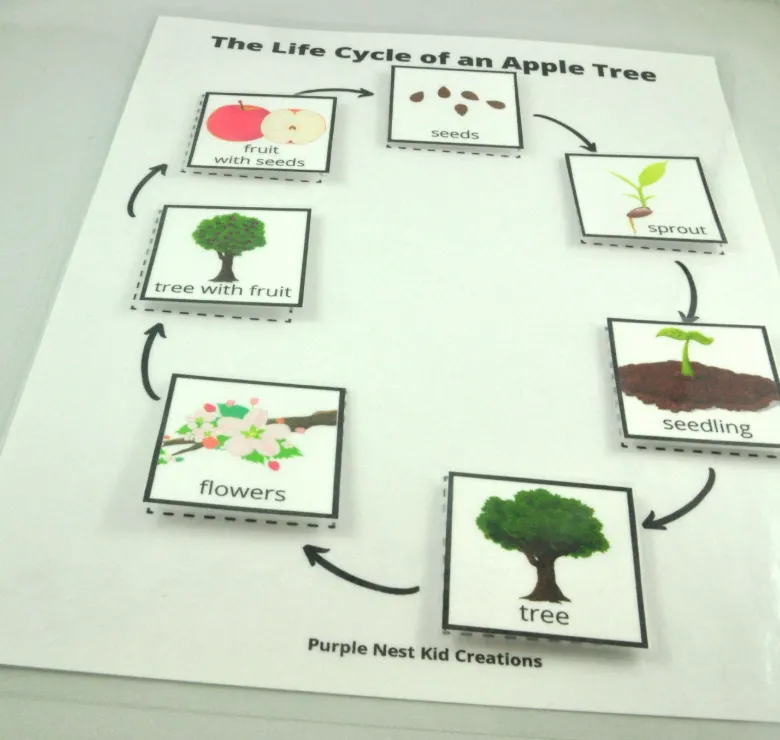
A: The life cycle of an apple tree includes seed, germination, seedling, sapling, mature flowering tree, fruiting tree, and aging tree stages.
Q: How long does an apple tree take to grow from seed?
A: An apple seed can germinate within weeks or months under suitable conditions, but the tree may take several years to become mature enough to flower and fruit.
Q: Why does my apple tree flower but not produce apples?
A: Common reasons include poor pollination, lack of a compatible variety nearby, frost damage, young tree age, disease, or weak tree health. Most apple trees need cross-pollination for good fruit set.
Q: Can one apple tree produce fruit alone?
A: Some varieties may produce a small amount alone, but most apple trees need pollen from another compatible apple or crabapple tree for a reliable crop.
Q: What is the best condition for an apple tree to grow?
A: Apple trees grow best in full sun, well-drained, fertile soil, enough spacing, proper pruning, and regular water during dry periods. They need at least 8 hours of sunlight during the growing season.
Conclusion
The life cycle of an apple tree is a beautiful example of how plants grow, reproduce, and support ecosystems. From a small apple seed, the tree develops roots, leaves, branches, flowers, and finally fruit. Each stage depends on sunlight, water, nutrients, pollination, and seasonal change.
An apple tree is not only valuable for producing apples. It also supports bees, birds, insects, soil organisms, wildlife, and human food systems. Its history connects modern orchards with ancient wild apple forests of Central Asia, especially Malus sieversii.
To protect apple trees for the future, we must care for pollinators, conserve wild apple relatives, grow diverse varieties, and use sustainable orchard practices. A healthy apple tree can live for decades and continue giving fruit, shade, beauty, and ecological value for generations.
Also Read: carpet beetle life cycle