
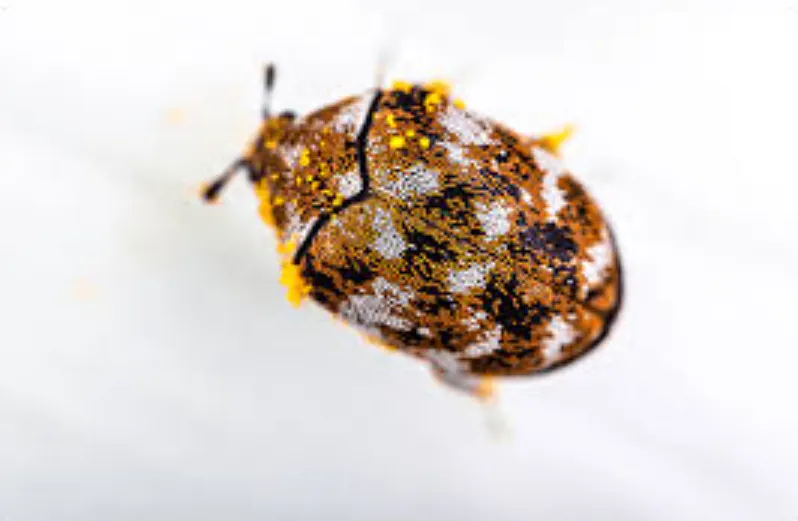
The varied carpet beetle life cycle is one of the most interesting examples of complete metamorphosis in small household and outdoor insects. The varied carpet beetle, scientifically known as Anthrenus verbasci, belongs to the beetle family Dermestidae, a group often called skin beetles or carpet beetles. Although the adult beetle is tiny, usually around 1/10 inch long, its larval stage can survive for months and is the main stage responsible for feeding on wool, fur, feathers, dried insects, and other natural materials.
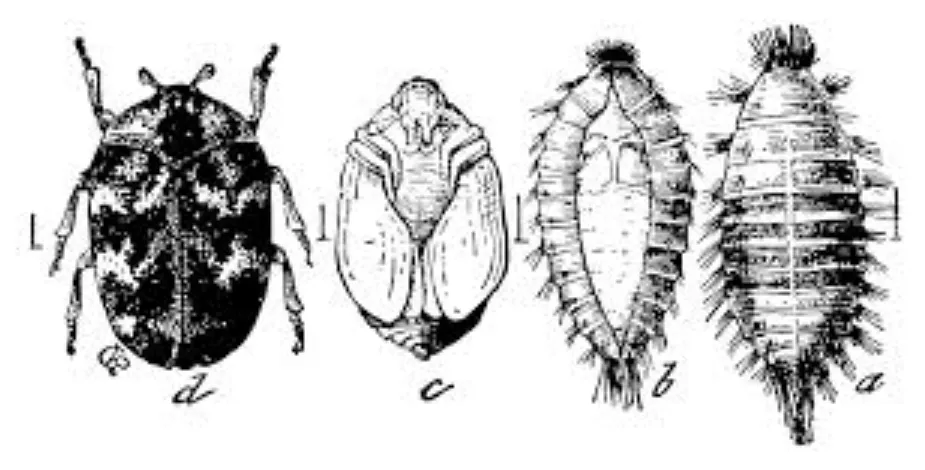
This insect passes through four major stages: egg, larva, pupa, and adult. The larval stage is the longest and most active feeding period, while the adult stage is shorter and often linked with flying, mating, and finding suitable places to lay eggs. In homes, adults are often seen near windows in spring or early summer, while larvae hide in dark, quiet places such as under furniture, inside stored fabrics, around lint, and near natural animal-based materials.
Understanding the varied carpet beetle lifespan, feeding habits, reproduction, and ecological role helps readers identify this insect correctly. It also helps people control indoor infestations responsibly while still respecting its natural role in recycling dead organic matter outdoors.
Q: What are the stages of the varied carpet beetle life cycle?
A: The varied carpet beetle life cycle has four stages: egg, larva, pupa, and adult.
Q: Which stage causes the most damage?
A: The varied carpet beetle larvae cause the most damage because they feed on wool, silk, fur, feathers, hair, dead insects, and similar organic materials.
Q: How long does a varied carpet beetle live?
A: The complete life cycle may last many months to more than a year, depending on food, temperature, and environment. Adult females often live 2–6 weeks, while adult males live 2–4 weeks.
Quick Life Cycle Table
| Life Stage | Duration / Key Time | Main Activity |
| Egg | About 10–20 days | Laid near larval food sources such as wool, fur, feathers, nests, lint, or dried organic matter |
| Larva | About 220–630 days in varied carpet beetles | Longest stage; feeds on keratin, chitin, dry animal material, and organic debris. |
| Pupa | About 10–13 days | Transformation stage before adult emergence |
| Adult | Female: 2–6 weeks; Male: 2–4 weeks | Flies, mates, feed on pollen outdoors, and lay eggs near suitable larval food. |
| Full cycle | Often, several months to over a year | Faster in warm indoor conditions; slower in outdoor or cooler conditions |
The larval stage is the most important stage to understand because it lasts the longest and causes the most feeding damage. UC IPM reports that varied carpet beetles typically lay about 40 eggs; eggs hatch in 10–20 days; larvae live 220–630 days; and pupae last 10–13 days before adults emerge.
The History of Their Scientific Naming
The scientific name of the varied carpet beetle is Anthrenus verbasci. This name helps scientists distinguish it from other similar carpet beetles that may look almost identical to the human eye.
Key naming points:
- Anthrenus verbasci is placed in the kingdom Animalia, class Insecta, order Coleoptera, family Dermestidae, genus Anthrenus, and species Anthrenus verbasci.
- The family Dermestidae is associated with “skin beetles” because many members feed on dry animal materials such as skin, hair, feathers, and hides.
- The common name, the varied carpet beetle, comes from the adult’s mixed pattern of white, brown, black, and yellowish scales on the wing covers.
- The word varied refers to the beetle’s mottled, uneven color pattern.
- The term carpet beetle became common because larvae often feed on carpets and household fabrics made from natural animal fibers.
Scientific naming is important because many small beetles are misidentified. For example, the varied carpet beetle adult may be confused with furniture carpet beetles or black carpet beetles. Accurate naming makes it easier to understand its true life cycle, food habits, and control methods.
Their Evolution And Their Origin
The varied carpet beetle belongs to the beetle order Coleoptera, one of the most successful insect groups on Earth. Beetles have existed for hundreds of millions of years, and their hard front wings, chewing mouthparts, and ability to adapt to many food sources helped them survive in forests, grasslands, nests, homes, stored products, and museum collections.
The family Dermestidae includes carpet beetles, hide beetles, larder beetles, and related species. These insects are strongly connected with dry organic matter. In natural habitats, many dermestid larvae feed on dead insects, feathers, skin, hair, dry carcass remains, bird nests, mammal nests, and other protein-rich remains. This feeding habit made them important recyclers in nature.
Modern varied carpet beetle larvae are especially adapted to feeding on materials that many insects cannot digest easily. They can use materials containing keratin and chitin, such as feathers, hair, wool, dried insects, and animal remains. The Natural History Museum notes that females lay eggs on or near food sources containing keratin and chitin, and larvae grow through feeding periods followed by resting periods called diapause.
Their origin is commonly linked with outdoor habitats such as bird nests, wasp nests, spider webs, and dry animal debris. Over time, as humans stored wool, carpets, furs, dried specimens, and natural-fiber fabrics indoors, the beetle found new artificial habitats. That is why Anthrenus verbasci is now common in homes, museums, and storage areas, while still maintaining outdoor populations.
Animal Diversity Web describes Anthrenus verbasci as a cosmopolitan species with a nearly worldwide distribution and originally associated with the Palearctic region. It has also been recorded as introduced in North America around the mid-19th century.
Important Things That You Need To Know
The varied carpet beetle is small, but its biology is complex. Many people notice the adult first, but the larval stage is usually the real cause of fabric damage.
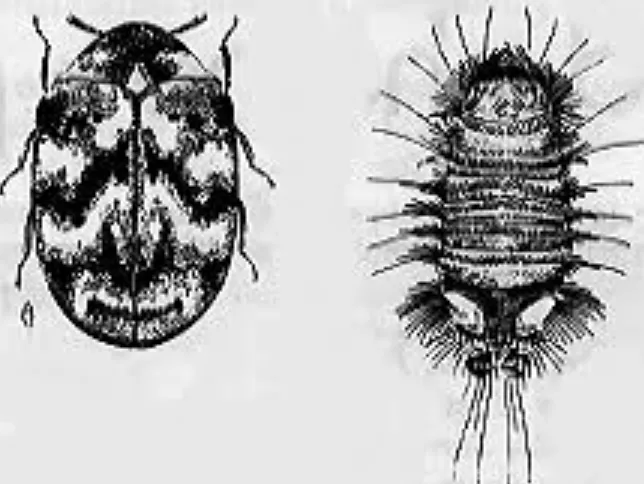
The adult beetle is oval, tiny, and patterned with irregular white, brown, and dark yellow scales. Older adults may look darker because these scales can wear off. This is why identifying a varied carpet beetle adult only by color can sometimes be misleading.
The most important LSI terms to understand are varied carpet beetle, varied carpet beetle life cycle, varied carpet beetle larvae, varied carpet beetle lifespan, and varied carpet beetle adult. These terms describe the insect from identification to survival.
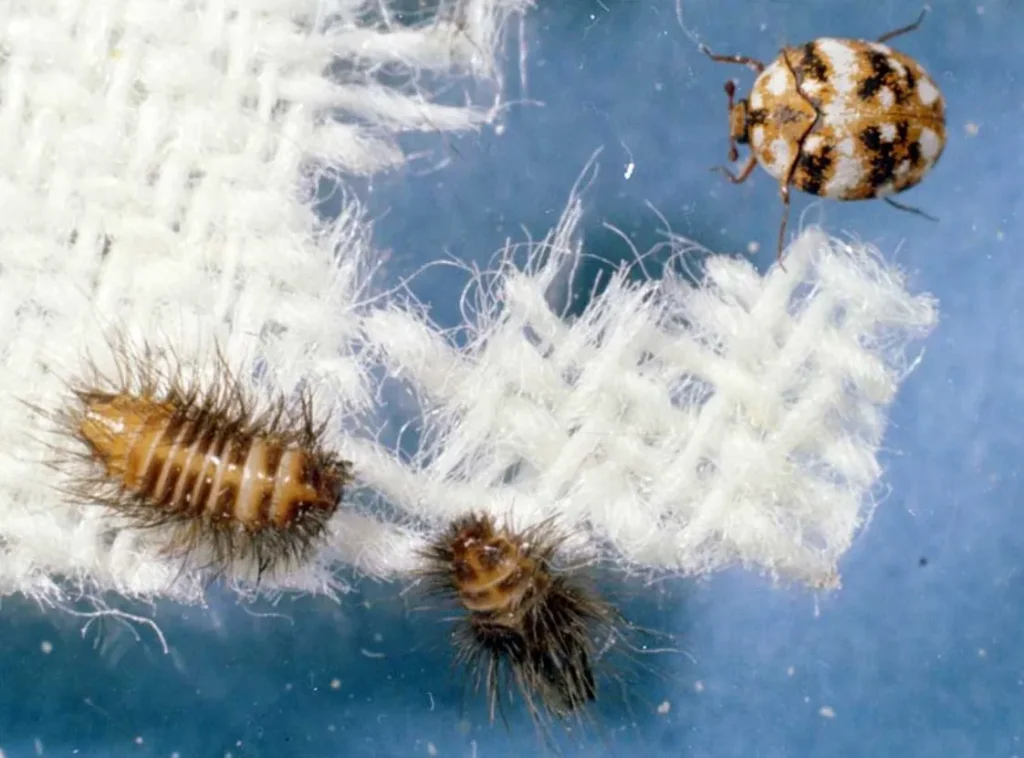
The varied carpet beetle larvae are covered with dense hairs and have alternating light and dark brown stripes. They are broader toward the rear and narrower toward the front. When disturbed, the larvae may raise their hair tufts, a useful identification cue.
The carpet beetle’s lifespan varies widely depending on temperature, food quality, and whether the insect develops indoors or outdoors. Indoors, the cycle may finish faster because rooms can stay warmer and more stable. Outdoors, development may take longer because larvae may enter diapause in winter.
The varied carpet beetle adult does not normally cause fabric damage. Adults often feed on pollen outdoors and are attracted to light. When seen indoors near windows, they may indicate that larvae are already feeding somewhere hidden.
Their main food and its collection process
The varied carpet beetle larvae are the main feeding stage. Their diet is rich in dry animal-based material, especially items that contain keratin, chitin, and natural protein.
Main food sources include:
- Wool carpets and wool clothing
- Fur, feathers, hair, and animal skins
- Silk and leather items
- Pet hair and lint mixed with organic debris
- Dead insects in spider webs or window areas
- Bird nests, wasp nests, and rodent nests
- Museum specimens and dried insect collections
- Stored food items, in some cases, such as grains, spices, nuts, or dry pet food
UC IPM and museum pest references both note that larvae feed on dead animal products such as wool, silk, leather, fur, hair, feathers, and sometimes stored products. They do not normally feed on clean synthetic fibers, though soiled fabrics may become attractive if contaminated with food, sweat, or animal material.
Their food collection process is simple but effective. The adult female searches for a safe place near larval food. Indoors, this may be behind baseboards, under heavy furniture, inside closets, in air ducts, or near woolen goods. Outdoors, it may be in bird nests, bee nests, wasp nests, spider webs, or dry organic debris.
After eggs hatch, larvae begin feeding close to the food source. They avoid light and prefer dark, undisturbed places. If food becomes limited, larvae can wander to another area, which explains why infestations sometimes spread from one room to another.
Their life cycle and ability to survive in nature
Egg Stage
The egg stage begins when an adult female lays eggs near food suitable for larvae. In varied carpet beetles, females typically lay about 40 eggs, and these eggs may hatch in 10–20 days under suitable conditions.
Eggs are usually hidden, so people rarely see them. Indoors, they may be placed near lint, wool, feathers, pet hair, or stored natural materials.
Larval Stage
The larval stage is the longest and most important survival stage. Larvae feed actively on dry organic matter and can remain hidden for months. In varied carpet beetles, larvae may live 220–630 days before pupating.
This long larval period allows them to survive when food is limited. Colorado State University Extension also notes that dermestid larvae can survive for weeks if food disappears and can wander considerable distances in search of new food.
Pupal Stage
When fully grown, the larva changes into a pupa. In varied carpet beetles, the pupal period lasts about 10–13 days. During this stage, the insect transforms into an adult.
Pupation may happen inside the last larval skin or in a protected place near the food source.
Adult Stage
The varied carpet beetle adult is the reproductive and dispersal stage. Adults can fly, are often attracted to light, and may be found near windows indoors.
Outdoors, adults often feed on pollen from flowers. The adult stage is short compared to the larval stage, but it is essential for mating and egg-laying.
Their Reproductive Process and raising their children
The reproductive process of the varied carpet beetle is simple but highly successful. Adult beetles emerge, mate, and females search for suitable egg-laying sites.
Important reproductive points:
- Adult carpet beetles can mate after emergence and reproduce without much additional feeding. Virginia Tech notes that adult carpet beetles can mate and reproduce after emergence, and females lay eggs in protected places depending on the species.
- Females choose food-rich places so the newly hatched larvae do not need to travel far immediately.
- Eggs are laid near larval food, such as wool, fur, feathers, dead insects, lint, or nests.
- There is no parental care after egg laying. The female does not feed or guard the larvae.
- Larvae raise themselves by hiding, feeding, molting, and moving away from light.
- Molting helps growth, and carpet beetle larvae may molt several times as they develop. Virginia Tech reports that carpet beetle larvae can molt 5–12 times, depending on conditions.
- The larvae’s hair and hidden behavior support survival, especially against disturbance and predators.
Although they do not “raise children” like mammals or birds, the female’s egg-laying choice is a reproductive strategy; by placing eggs near wool, feathers, nests, or organic debris, she gives the next generation the best chance to survive.
This strategy is why infestations often begin in hidden areas. By the time adults are seen near windows, larvae may already have completed much of their feeding period.
The importance of them in this Ecosystem
Natural Recyclers
The varied carpet beetle is often considered a pest indoors, but in nature, it plays an important role in recycling. Its larvae help break down dry animal remains such as feathers, hair, dead insects, and nest debris.
These materials are difficult for many organisms to digest. By feeding on them, varied carpet beetle larvae help return nutrients to the environment.
Part of Nest and Decomposition Systems
Outdoors, carpet beetles are often found in bird nests, wasp nests, bee nests, spider webs, rodent nests, and in dry animal remains. These places contain feathers, hair, skins, dead insects, and other organic waste.
By consuming these remains, the beetles help keep natural nesting environments cleaner over time.
Food for Other Organisms
The beetles also become food for predators and parasitoids. Small predatory insects, spiders, and parasitoid wasps may prey on or host larvae or adults.
This places the varied carpet beetle inside a larger food web, not just as a pest but as part of ecological balance.
Scientific and Museum Importance
The species is important in stored-product research, museum pest management, and insect behavior studies. Museum pest guidance identifies Anthrenus verbasci as one of the common carpet beetle species found in homes and museum settings, where larvae may damage collections.
So, its importance is double-sided. In nature, it recycles waste. Indoors, it can damage valuable items if populations are not managed.
What to do to protect them in nature and save the system for the future
Protecting the varied carpet beetle does not mean allowing infestations inside homes. It means using balanced methods that protect natural ecosystems while safely managing indoor problems.
- Avoid unnecessary outdoor pesticide use.
- Broad pesticide spraying can harm beetles, pollinators, predators, and other useful insects.
- Protect natural decomposition zones.
- Dead leaves, old nests away from buildings, fallen organic matter, and natural debris support many decomposer insects.
- Use indoor sanitation first.
- Regular vacuuming, cleaning lint, removing pet hair, and storing woolens properly can reduce infestations without heavy chemical use.
- Seal entry points instead of killing everything
- Use screens, close cracks, and manage attic openings to stop beetles from entering homes.
- Remove old nests from buildings carefully.
- Bird or wasp nests attached to homes can become sources of carpet beetles. Remove abandoned nests safely, but avoid disturbing active protected wildlife nests.
- Store natural fabrics responsibly.
- Clean wool, silk, fur, and feather items before storage. Use sealed containers or bags.
- Use freezing for delicate infested items when possible
- The Natural History Museum notes that affected items can be bagged and placed in a deep freezer where feasible.
- Keep Ecosystem thinking in mind.
- The goal is not to remove every beetle from nature. The goal is to prevent indoor damage while allowing outdoor decomposers to perform their natural work.
Frequently Asked Questions (FAQs)
Q1: What is the varied carpet beetle life cycle?
A: The varied carpet beetle life cycle includes four stages: egg, larva, pupa, and adult. It is a complete metamorphosis cycle.
Q2: How long do varied carpet beetle larvae live?
A: Varied carpet beetle larvae may live around 220–630 days before pupating, depending on food and temperature.
Q3: What do varied carpet beetle larvae eat?
A: They eat wool, silk, fur, feathers, leather, hair, dead insects, pet hair, lint, and sometimes stored food products.
Q4: Do varied carpet beetle adults damage clothes?
A: No, the varied carpet beetle adult is not the main damaging stage. The larvae cause most damage.
Q5: Where do varied carpet beetles lay eggs?
A: Females lay eggs near larval food sources, such as wool carpets, stored fabrics, bird nests, wasp nests, lint, feathers, or dead insects.
Q6: What is the varied carpet beetle’s lifespan?
A: The full varied carpet beetle lifespan can vary widely. Adult females live about 2–6 weeks, and adult males live about 2–4 weeks, while the full cycle may take many months or longer.
Q7: Are varied carpet beetles harmful to humans?
A: They do not bite like bed bugs or mosquitoes. However, larval hairs and shed skins may irritate sensitive skin in some people.
Q8: How can I identify varied carpet beetle larvae?
A: The larvae are hairy, brown-striped, and slightly wider at the rear. They may raise dense hair tufts when disturbed.
Conclusion
The varied carpet beetle life cycle shows how a tiny insect can survive successfully in both natural and human-made environments. From hidden eggs to long-lived, varied carpet beetle larvae, from the short pupal stage to the flying, adult, each stage has a clear role. The larvae are the most important stage because they feed on wool, feathers, fur, dead insects, and other dry organic materials.
Although this beetle can damage carpets, clothes, museum specimens, and stored items, it also has ecological value outdoors. In nature, it helps recycle feathers, hair, dry animal remains, and nest debris. The best approach is balanced management: protect natural decomposers outdoors while preventing indoor infestations through cleaning, sealed storage, careful inspection, and, whenever possible, non-toxic control methods. Understanding Anthrenus verbasci deeply helps us manage it wisely, not unquestioningly.
Also Read: tomato hornworm life cycle