
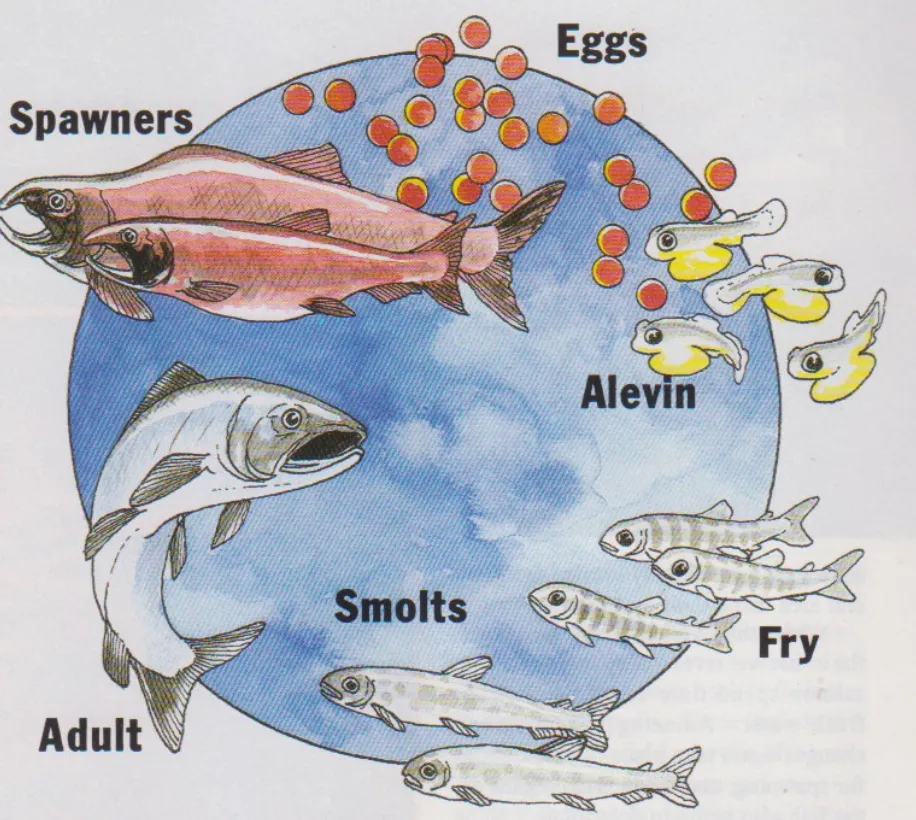
The life cycle of salmon is one of the most fascinating journeys in nature. Salmon are famous for being anadromous fish, meaning many species hatch in freshwater, migrate to the ocean to grow, and later return to freshwater to reproduce. This journey connects rivers, lakes, estuaries, oceans, forests, predators, and even human communities.
Most people know salmon as a healthy food used in salmon recipes, baked salmon, air fryer salmon, and smoked salmon, but biologically, salmon are much more than food. They are powerful migratory fish that support entire ecosystems. Their bodies carry nutrients from the ocean back into rivers and forests, helping feed bears, birds, insects, plants, and microorganisms. National Park Service materials describe the salmon life cycle through stages, including eggs, alevins, fry, smolts, migrating adults, spawning adults, and post-spawning carcasses that recycle nutrients into the ecosystem.
The life cycle varies by species. Pacific salmon generally die after spawning, while Atlantic salmon may survive and spawn more than once. NOAA explains that Atlantic salmon can repeat spawning, while most Pacific salmon die shortly after reproduction.
Quick Answers
Q: What are the main stages in the life cycle of salmon?
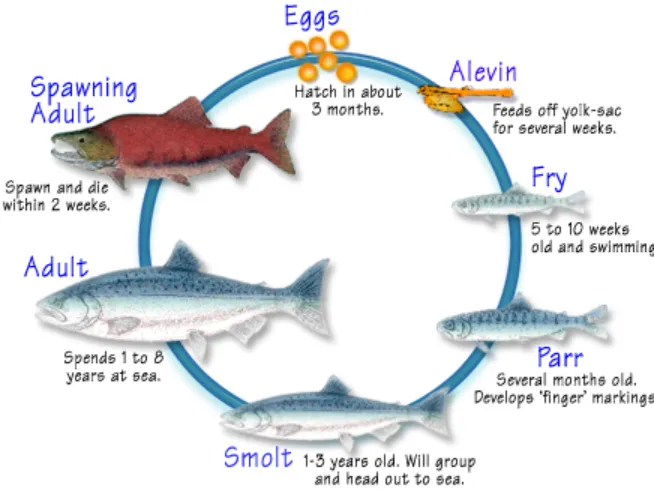
A: The main stages are egg, alevin, fry/parr, smolt, adult, and spawning adult. These stages move salmon from freshwater birth to ocean growth and back to freshwater reproduction.
Q: How long do salmon live?
A: Many salmon live around 2 to 7 years, depending on the species. For example, NOAA notes that sockeye salmon commonly mature after 2 to 3 years at sea and have a total lifespan of about 4 to 5 years.
Q: Do salmon die after laying eggs?
A: Most Pacific salmon die shortly after spawning. Atlantic salmon may survive and return to spawn again, although many still die after reproduction.
Quick Life Cycle Table
| Stage | Where It Happens | What Happens | Main Risk |
| Egg | Freshwater gravel nest | Female lays eggs in a redd | Predators, silt, low oxygen |
| Alevin | Under gravel | Baby salmon use the yolk sac for food | Disturbance, poor water quality |
| Fry / Parr | Streams, rivers, lakes | Young salmon begin feeding and growing | Birds, fish, insects |
| Smolt | River to estuary | The body adapts from freshwater to saltwater | Predation, migration stress |
| Adult | Ocean or large lake | Salmon grows quickly and feeds heavily | Fishing, predators, climate stress |
| Spawning Adult | Birth river or stream | Salmon return, mate, and lay eggs | Dams, warm water, exhaustion |
The History of Their Scientific Naming, Evolution, and Origin
Scientific Naming of Salmon
The name salmon refers to several fish species, mainly from two important genera: Salmo and Oncorhynchus. Atlantic salmon belongs to the genus Salmo, while Pacific salmon belong mostly to Oncorhynchus. NOAA explains that Atlantic salmon is a species in the genus Salmo, while Pacific salmon includes multiple species in the genus Oncorhynchus.
Evolutionary Background
Salmon evolved as strong migratory fish adapted to both freshwater and saltwater environments. Their bodies can change during smoltification, allowing them to survive the shift from rivers to the ocean. This ability enabled salmon to access rich ocean food while still using safer freshwater habitats for reproduction.
Origin and Natural Distribution
Historically, salmon were found across the cold, oxygen-rich waters of the North Atlantic and North Pacific. Their origin is closely connected to clean rivers, gravel beds, estuaries, and ocean feeding grounds. Over time, different salmon species adapted to local river systems, creating unique populations that return to specific spawning areas.
Their Reproductive Process, Giving Birth And Rising Their Children
Spawning Migration
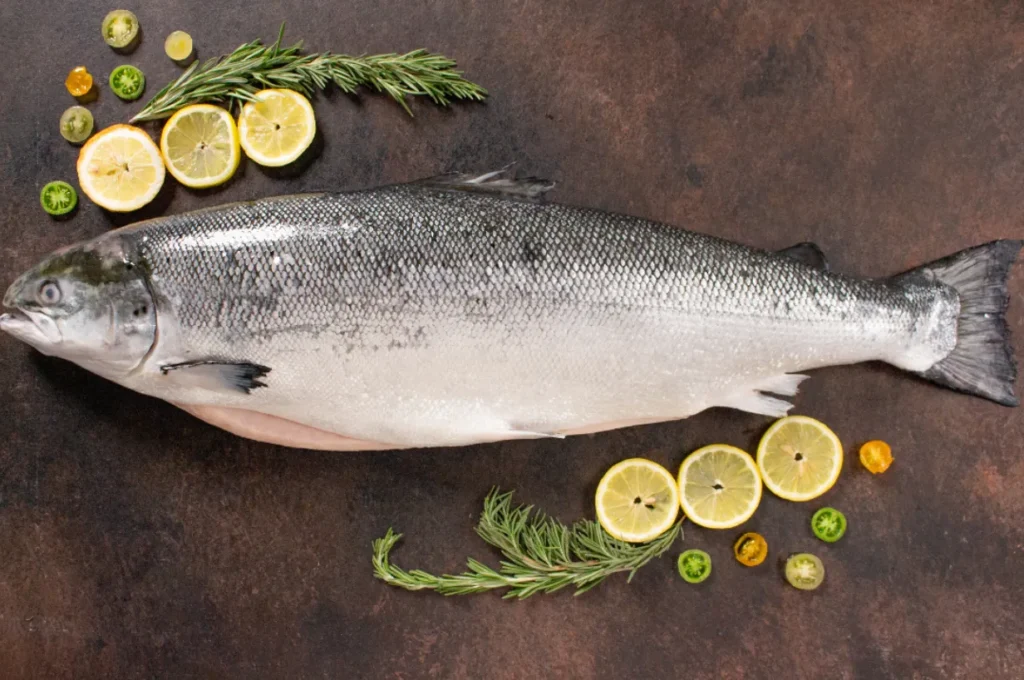
The reproductive process begins when adult salmon leave the ocean and swim back toward freshwater. Many salmon return to the same river or stream where they hatched. This behavior, called homing, is one of the most remarkable instincts in the animal kingdom.
They use environmental signals such as smell, water chemistry, river flow, and temperature to find their spawning grounds. The journey is physically demanding because adult salmon often stop feeding and use stored body energy.
Nest Building and Egg Laying
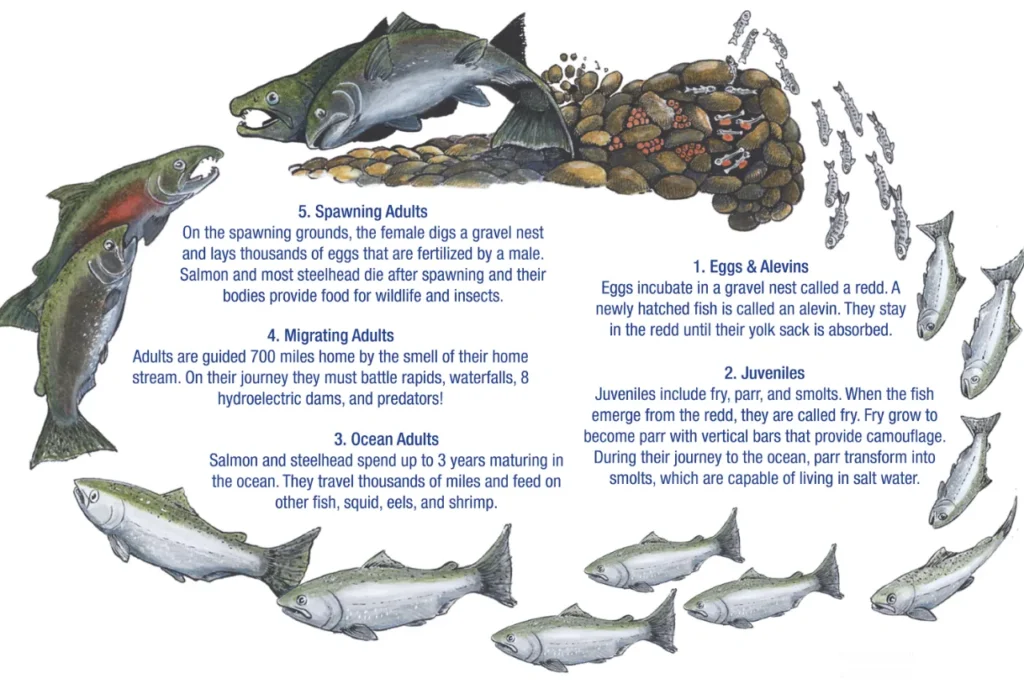
A female salmon creates a nest in the gravel called a redd. She uses her tail to dig a shallow depression in clean river gravel. According to the U.S. Fish and Wildlife Service, female salmon may lay between 1,000 and 17,000 eggs, but only a small percentage survive long enough to hatch.
After the female releases eggs, the male releases milt, which fertilizes them. Then the female covers the eggs with gravel to protect them from predators and strong currents.
Raising Their Young
Salmon do not raise their young like mammals or birds. After eggs are laid and fertilized, the embryos develop independently inside the gravel. The parent Pacific salmon usually die after spawning, and their bodies provide nutrients to the river system.
The young salmon hatch as alevins and remain hidden under the gravel while feeding on their yolk sacs. When they become stronger, they emerge as fry and begin searching for tiny aquatic food.
Stages of the Life Cycle of Salmon
Although the full life cycle of salmon can include six or more detailed steps, it can be explained clearly in four major stages.
Stage 1: Egg and Alevin Stage
The life cycle begins when a female lays eggs in a gravel nest. These eggs need cold, clean, oxygen-rich water. If the gravel becomes covered with mud or pollution, oxygen flow may decrease, leading to embryo death.
After hatching, the baby salmon is called an alevin. It still has a yolk sac attached to its body. This sac provides food while the alevin hides under the gravel. The Marine Institute explains that alevins remain attached to the yolk sac and become more active after the yolk is absorbed.
Stage 2: Fry and Parr Stage
Once the yolk sac is absorbed, the young fish becomes a fry. It swims up from the gravel and starts feeding. Fry eat tiny insects, plankton, and small aquatic animals.
As the fry grows, it becomes a parr. Parr have dark vertical markings on their sides, which help them hide from predators in streams and rivers.
Stage 3: Smolt and Ocean Migration Stage
The next stage is the smolt stage. Smolts develop silvery bodies and prepare for life in saltwater. This biological change is called smolting.
The Pacific Salmon Foundation explains that smolting helps young salmon manage the transition from freshwater to saltwater and that smolts develop a silvery coating that helps with camouflage and protection during migration.
Stage 4: Adult and Spawning Stage
In the ocean, salmon grow quickly by eating protein-rich food. When mature, they return to freshwater to spawn. Some travel hundreds of miles upstream.
During spawning, their bodies change color and shape. After reproduction, most Pacific salmon die. Their carcasses become food for wildlife and nutrients for rivers and forests.
Their main diet, food sources, and collection process are explained
The diet of salmon changes as they grow. Young salmon eat small freshwater organisms, while adult salmon in the ocean eat larger prey. Their feeding habits are important because they transfer energy from small aquatic life to larger predators.
Food Sources of Young Salmon
Young fry and parr feed on tiny animals found in streams, rivers, and lakes. Their diet includes:
- Zooplankton
- Aquatic insect larvae
- Small crustaceans
- Tiny worms
- Surface insects
- Small freshwater organisms
They collect food by actively swimming, drifting with currents, and capturing prey from the water column or river surface.
Food Sources of Adult Salmon
Adult salmon feed more aggressively in the ocean. Depending on species and habitat, they may eat:
- Small fish
- Krill
- Shrimp-like crustaceans
- Squid
- Marine insects
- Planktonic organisms
Ocean feeding allows salmon to gain the body mass and energy needed for migration and spawning.
How Salmon Collect Food
Salmon are visual hunters. They use quick swimming, sharp turns, and strong jaws to capture prey. Young salmon often wait in flowing water and catch drifting insects. Adult salmon chase prey in open water.
Before spawning, many adult salmon stop feeding. Their bodies rely on stored fat and muscle energy to complete migration, build nests, reproduce, and survive long enough to finish the cycle.
Important Things That You Need To Know
Many readers search for salmon because they want information about food, health, cooking, or wildlife. However, understanding the life cycle of salmon helps connect the fish on the plate with the living animal in rivers and oceans.
A salmon recipe often focuses on flavor, nutrition, and cooking time, but wild salmon begins life as a tiny egg under gravel. Before becoming a meal in human kitchens, it may migrate from a cold stream to the ocean and return years later to reproduce.
A baked salmon recipe is popular because salmon is rich, tender, and easy to prepare. Still, sustainable seafood choices matter because salmon populations depend on clean rivers, healthy estuaries, and responsible fishing.
Air fryer salmon has become popular for quick home cooking, especially because it uses less oil and cooks fast. But from an ecological view, every salmon species has a natural role beyond food.
Smoked salmon is another well-known product, often used in breakfast dishes, sandwiches, and appetizers. Yet salmon are also nutrient carriers that move marine energy into freshwater and forest ecosystems.
So, whether people search for baked salmon, air fryer salmon, smoked salmon, or the life cycle of salmon, the deeper truth is the same: salmon are valuable as food, wildlife, cultural symbols, and ecosystem builders.
How Long Does A Salmon Live
The lifespan of salmon depends on species, habitat, temperature, food availability, migration distance, and survival risks. There is no single lifespan for all salmon because different species follow different life histories.
- Pink salmon usually have one of the shortest life cycles, often around 2 years.
- Sockeye salmon commonly live for 4 to 5 years. NOAA notes that sockeye salmon often return to freshwater after 2 to 3 years at sea, though some may return later after 4 to 5 years.
- Coho salmon often live around 3 to 4 years, depending on the region and conditions.
- Chinook salmon, also called king salmon, may live longer than many other salmon species. Some individuals may live up to 6 or 7 years.
- Atlantic salmon may live several years and may spawn more than once, unlike most Pacific salmon.
- Survival is extremely low from egg to adult. The U.S. Fish and Wildlife Service notes that only about 1% of eggs live to adulthood, showing how difficult the salmon life cycle is.
- Early life stages are subject to heavy predation by insects, fish, birds, and other animals.
- Smolts face a high risk when moving through estuaries because they must adapt to saltwater while avoiding predators.
- Adult salmon face ocean predators, fishing pressure, disease, warming water, and migration barriers.
- Spawning adults often die from exhaustion after reproduction, especially Pacific salmon.
In simple terms, a salmon’s life may be short, but it is intense, purposeful, and ecologically powerful. Its entire body is shaped for migration, feeding, reproduction, and nutrient transfer.
Life Cycle of Salmon Lifespan in the Wild vs. in Captivity
Lifespan in the Wild
In the wild, salmon live under natural pressure. They face predators, storms, changing water temperature, pollution, fishing, dams, and disease. Their lifespan depends heavily on survival through each stage.
Wild salmon must complete their migration. Eggs must survive in gravel, fry must find food, smolts must reach the ocean, and adults must return to spawn. This makes wild salmon strong but vulnerable.
Lifespan in Captivity
In captivity, salmon may be protected from many predators and fed regularly. Farmed salmon are usually raised for production, not for completing a natural life cycle.
Their environment is controlled, including feeding, water management, and disease monitoring. However, captivity also poses risks, including crowding, parasites, disease transmission, and reduced natural behavior.
Key Difference
The lifespan of wild salmon is shaped by migration and ecological factors. The lifespan of captive salmon is shaped by human management. Wild salmon complete a natural biological journey, while farmed salmon are usually harvested before reaching an old age.
Importance of the Life Cycle of Salmon in this Ecosystem
Salmon Move Ocean Nutrients into Rivers
Salmon are often called a bridge between the ocean and freshwater. They feed in the sea, grow large, and return inland. When they spawn and die, their bodies release marine nutrients into rivers and nearby forests.
The National Park Service explains that salmon feed ecosystems not only by feeding bears but also by providing nutrients from their carcasses, which support streams and riparian vegetation.
Salmon Feed Many Animals
Many animals depend on salmon. Bears, eagles, otters, wolves, seals, insects, and other fish may feed on salmon or salmon eggs. Even dead salmon support scavengers and microorganisms.
Salmon Support Forest Growth
Research on salmon-derived nutrients shows that nitrogen from salmon can contribute to soil fertility and forest productivity near salmon streams.
Salmon Indicate River Health
Healthy salmon populations often mean healthy rivers. Salmon need clean water, stable gravel beds, cool temperatures, and connected habitats. If salmon decline, it may indicate problems in the wider ecosystem.
Salmon Support Human Communities
Salmon are important for food, culture, recreation, commercial fishing, and Indigenous traditions. Their life cycle supports not only wildlife but also local economies and cultural identity.
What to do to protect them in nature and save the system for the future
Protect Clean Freshwater Habitats
- Keep rivers, streams, and lakes clean.
- Reduce chemical pollution, plastic waste, and harmful runoff.
- Protect gravel beds where salmon lay eggs.
- Maintain cool, oxygen-rich water.
Restore River Connectivity
- Remove unnecessary barriers where possible.
- Build effective fish passages around dams.
- Improve culverts so smolts and adults can migrate safely.
- Protect natural river flow patterns.
Reduce Overfishing and Support Sustainable Choices
- Follow science-based fishing limits.
- Choose responsibly sourced salmon.
- Support fisheries that protect spawning populations.
- Avoid illegal or unregulated harvest.
Protect Forests and Riverbanks
- Preserve trees along rivers.
- Prevent erosion that can bury salmon eggs.
- Maintain shade to keep water cool.
- Restore damaged riparian zones.
Address Climate and Water Temperature Stress
- Reduce greenhouse gas emissions.
- Protect cold-water refuges.
- Improve watershed management.
- Monitor drought, low flow, and heat impacts on salmon streams.
Fun & Interesting Facts About the Life Cycle of Salmon
- Salmon can remember the smell of their home stream and use it to return for spawning.
- Many salmon travel from freshwater to the ocean and back again, making them among nature’s most impressive migratory species.
- Female salmon build gravel nests called redds using their tails.
- Baby salmon are called alevins when they hatch with a yolk sac attached.
- Young salmon become smolts before entering saltwater.
- Most Pacific salmon die after spawning, giving their nutrients back to the ecosystem.
- Atlantic salmon may survive spawning and reproduce again.
- Salmon are an important food for bears, eagles, seals, otters, and many other animals.
- Salmon change color and body shape when they return to spawn.
- Some salmon stop eating during their final freshwater spawning journey.
- The life cycle of salmon helps connect oceans, rivers, forests, wildlife, and people.
Frequently Asked Questions (FAQs)
Q: What is the life cycle of salmon?
A: The life cycle of salmon includes egg, alevin, fry, parr, smolt, adult, and spawning adult stages. Salmon usually hatch in freshwater, migrate to the ocean, grow into adults, and return to freshwater to reproduce.
Q: Where do salmon lay their eggs?
A: Salmon lay eggs in freshwater gravel nests called redds. The female digs the nest with her tail, lays eggs, and covers them with gravel after fertilization.
Q: Why do salmon return to the same river?
A: Salmon return because of a natural homing instinct. They use smell, water chemistry, and environmental cues to locate the river or stream where they were born.
Q: Do all salmon die after spawning?
A: No. Most Pacific salmon die after spawning, but Atlantic salmon can sometimes survive and spawn again.
Q: What do baby salmon eat?
A: Baby salmon first feed from their yolk sac as alevins. Later, as fry and parr, they eat zooplankton, aquatic insects, larvae, and tiny freshwater organisms.
Q: How long do salmon stay in the ocean?
A: It depends on the species. Sockeye salmon often spend 2 to 3 years at sea, though some may stay longer before returning to spawn.
Q: Why are salmon important to the ecosystem?
A: Salmon feed wildlife, support forests, bring ocean nutrients into freshwater systems, and indicate river health. Their carcasses provide nutrients to streams and surrounding vegetation.
Conclusion
The life cycle of salmon is a powerful natural story of birth, migration, survival, reproduction, and renewal. From tiny eggs hidden in freshwater gravel to strong adults returning from the ocean, salmon show how deeply connected rivers and seas really are.
Their journey supports more than their own species. Salmon feed wildlife, nourish forests, support fishing communities, and help maintain healthy ecosystems. Whether people know salmon through nature, science, culture, or food, such as baked salmon, air fryer salmon, and smoked salmon, understanding their life cycle adds deeper respect for this remarkable fish.
Protecting salmon means protecting clean rivers, healthy oceans, cool water, migration routes, forests, and future generations. A healthy salmon life cycle is not only important for salmon; it is important for the entire natural system that depends on them.
Also Read: life cycle of an apple tree