
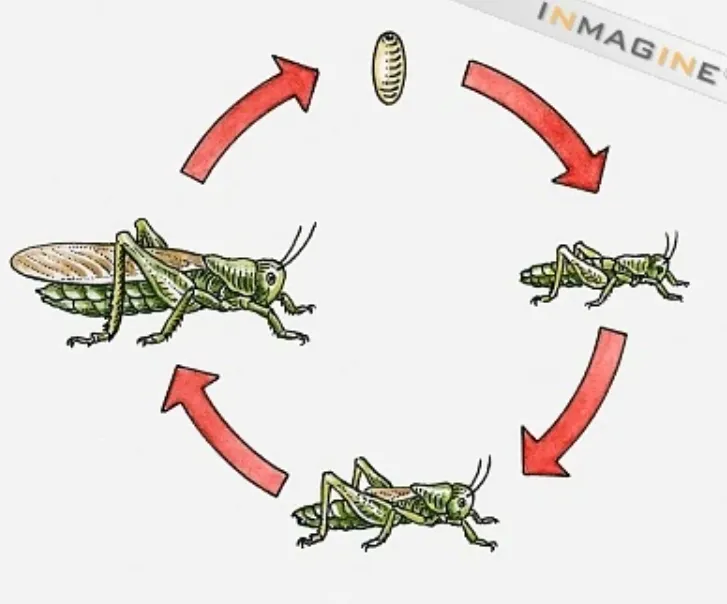
The grasshopper life cycle is one of the clearest examples of incomplete metamorphosis in the insect world. Unlike butterflies, beetles, or flies, a grasshopper does not pass through a pupal stage. Instead, it develops through three main stages: egg, nymph, and adult grasshopper. This simple yet highly effective life cycle helps grasshoppers survive in grasslands, farms, gardens, forests, and semi-dry habitats worldwide.
Grasshoppers belong to the insect order Orthoptera and the suborder Caelifera. They are known for their strong hind legs, chewing mouthparts, short antennae, and ability to jump long distances. Most grasshoppers are plant-eaters, and many species feed on grasses, leaves, crops, weeds, and other green vegetation. Although only some species become serious agricultural pests, grasshoppers are also important members of the food web because birds, frogs, snakes, spiders, and many other animals eat them.
Understanding the grasshopper life cycle is useful for students, gardeners, farmers, nature lovers, and pest-control planners. It explains when grasshoppers hatch, how grasshopper nymphs grow, why adults appear in large numbers during warm seasons, and how weather affects their survival.
Q: How many stages are in the grasshopper life cycle?
A: The grasshopper life cycle has three stages: egg, nymph, and adult.
Q: What type of metamorphosis does a grasshopper have?
A: A grasshopper has incomplete metamorphosis, meaning the young nymph looks like a smaller adult but does not have fully developed wings.
Q: Where do grasshoppers lay their eggs?
A: Most female grasshoppers lay eggs in the soil, usually inside protective egg pods during late summer or fall.
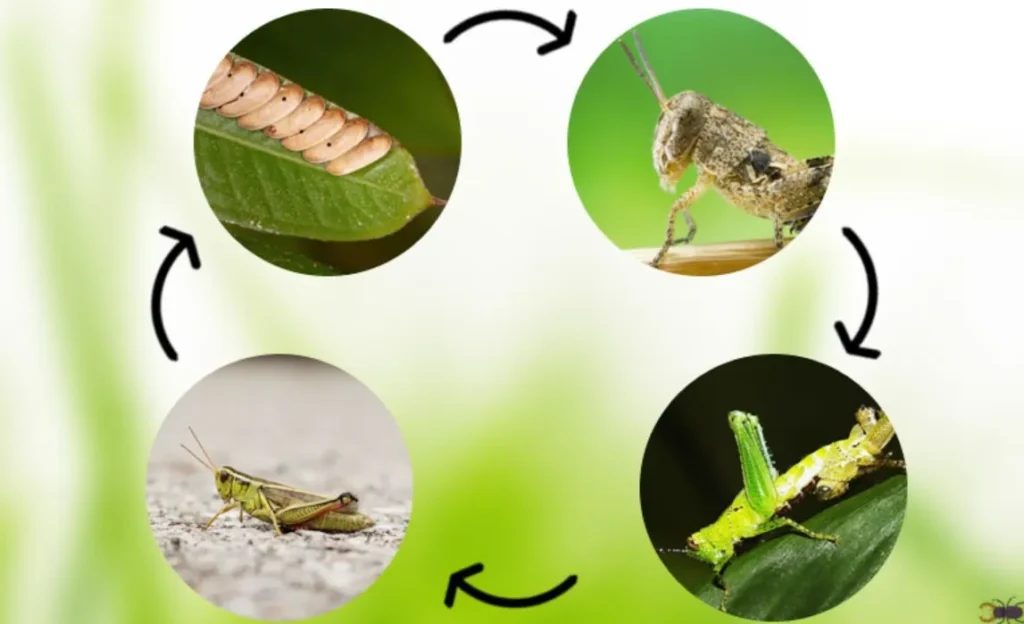
Quick Life Cycle Table
| Stage | What Happens | Simple Details |
| Egg | A female lays eggs in the soil | Eggs are usually placed in protective pods and may survive winter underground. |
| Nymph | Young grasshopper hatches | Nymphs look like small adults but have no full wings. They molt several times. |
| Growing Nymph | The body becomes larger | Most nymphs pass through about five molts before adulthood. |
| Adult Grasshopper | Fully grown stage | Adults can reproduce, jump strongly, feed actively, and many species can fly. |
| Reproduction | Mating and egg-laying | Females deposit eggs in soil, beginning the next generation. |
The History of Their Scientific Naming
The scientific naming of the grasshopper is connected to the history of insect classification. Grasshoppers are placed in the order Orthoptera, a group that includes grasshoppers, locusts, crickets, and katydids. The word Orthoptera comes from Greek roots meaning “straight wings,” referring to the folded, straight-looking wings of many insects in this order.
Grasshoppers are mainly grouped under the suborder Caelifera. This suborder includes short-horned grasshoppers, locusts, groundhoppers, and related insects. The name Caelifera is used in modern taxonomy to separate grasshoppers from the suborder Ensifera, which includes crickets and katydids. The Orthoptera Species File is one of the major taxonomic databases used for grasshoppers, locusts, crickets, katydids, and fossil relatives.
Important naming points:
- Grasshopper is a common name, not one single species name.
- The most familiar short-horned grasshoppers belong to the family Acrididae.
- Locusts are not a separate taxonomic group; they are grasshopper species that can form swarms under certain conditions.
- Current biological databases list thousands of grasshoppers and grasshopper-like species under Caelifera.
Their Evolution And Their Origin
The origin of grasshoppers goes deep into insect evolutionary history. Grasshoppers belong to the order Orthoptera, one of the oldest insect orders. Research combining genetic data and fossil evidence suggests that the order Orthoptera originated during the Carboniferous period, roughly 350–300 million years ago. Later, the two major orthopteran branches, Ensifera and Caelifera, diverged during the Permian period, about 300–250 million years ago.
This long history shows that grasshoppers are not recent insects. Their ancestors evolved during a time when early forests, ancient plants, and changing climates shaped insect body structures. Over time, the grasshopper’s body became highly adapted for jumping, chewing plants, sensing danger, and reproducing in seasonal environments.
The Acridoidea, a major grasshopper superfamily, became especially successful with the expansion of grasslands. Grasslands provided a huge food base, and grasshoppers became major consumers of plant biomass in those habitats. Their strong hind legs helped them escape predators, while their green, brown, or straw-colored bodies helped many species blend into dry grasses and leaves.
Modern grasshoppers are found in grasslands, tropical forests, semi-arid regions, farmlands, gardens, and open fields. Their evolutionary success comes from several traits: simple development, high reproductive output, plant-based feeding, fast movement, and the ability to survive seasonal changes. Many grasshoppers remain as eggs during harsh periods, allowing the next generation to hatch when temperature and food conditions improve.
Their main food and its collection process
Grasshoppers are mainly herbivorous insects, meaning they feed mostly on plant material. Their food collection process is simple but effective: they use their strong legs to move from plant to plant and their chewing mouthparts to cut and grind leaves, stems, flowers, and grasses.
Their main foods include:
- Grasses: Many species prefer grass blades, especially in meadows, pastures, and rangelands.
- Crop leaves: Some grasshoppers feed on corn, soybeans, wheat, vegetables, and other crops when populations are high.
- Weeds and wild plants: Wild vegetation often supports grasshopper nymphs before they move into cultivated areas.
- Leaves and soft stems: Young plant tissues are easier for nymphs to chew.
- Drying vegetation: During drought, natural vegetation may dry out, causing grasshoppers to move toward greener crops and gardens.
Grasshoppers collect food through active searching. They usually climb or jump onto plants and test plant surfaces with their sensory organs. Once they find suitable food, they use their mandibles to bite off pieces of the leaves. Their chewing damage often appears as irregular holes or missing leaf edges.
Not all grasshoppers eat the same plants. Some feed on many plant species, while others have narrower food preferences. Britannica notes that most grasshopper species are herbivorous, but only some become economically important crop pests.
Food availability strongly affects their life cycle. If nymphs hatch when fresh vegetation is abundant, they grow faster and survive better. If food is limited, many nymphs die before becoming adults. Weather, rainfall, plant growth, and habitat quality all influence how much food grasshoppers can collect.
Important Things That You Need To Know
The word “grasshopper” may seem simple, but it refers to a large and diverse group of insects. A grasshopper is not just one insect species; it is a common name used for many jumping, plant-eating insects in the suborder Caelifera. Current biological listings include more than 12,000 species of grasshoppers, locusts, and allies across thousands of genera, underscoring the group’s diversity.
One of the most important facts about the grasshopper life cycle is that it has no pupal stage. A butterfly changes from caterpillar to pupa to adult, but a grasshopper hatches as a grasshopper nymph that already looks like a tiny adult. As the nymph grows, it sheds its outer skin several times.
Another important point is that grasshopper eggs are usually hidden in the soil. This helps protect them from weather, predators, and seasonal changes. In many regions, eggs survive winter underground and hatch in spring or early summer when plants are available.
An adult grasshopper is the reproductive stage. Adults can mate, lay eggs, move longer distances, and, in many species, fly. This is why adult populations can suddenly become noticeable in gardens, farms, and grasslands.
Finally, grasshoppers are both helpful and harmful. They support birds, reptiles, frogs, spiders, and other predators, but some species can damage crops when their numbers rise too high. So, the best approach is not to destroy all grasshoppers but to understand their role in nature and manage them carefully.
Their life cycle and ability to survive in nature
Egg stage: The hidden beginning
The egg stage is the first and often longest part of the grasshopper life cycle. After mating, female grasshoppers usually deposit eggs in the soil during late summer or fall. Many species place eggs in undisturbed areas such as ditches, pastures, field edges, and grassy land.
Eggs are often grouped inside protective pods. These pods help reduce damage from cold, dryness, and some predators. In many climates, grasshoppers overwinter as eggs and hatch when temperature and soil conditions become favorable.
Nymph stage: Growth through molting
When eggs hatch, young grasshopper nymphs emerge. Nymphs look like small adult grasshoppers, but they do not have fully developed wings. They feed actively and grow through repeated molts. Many grasshopper nymphs go through about five molts before becoming adults.
This stage is risky because nymphs are small, soft-bodied, and vulnerable to birds, spiders, robber flies, disease, and harsh weather.
Adult stage: Movement and reproduction
The adult grasshopper has a harder body, stronger jumping ability, mature wings in many species, and reproductive organs. Adults feed, escape predators, find mates, and lay eggs for the next generation.
Their survival depends on warmth, food, moisture, camouflage, and predator pressure. Cold, wet weather can reduce the survival of young grasshoppers, while warm, dry conditions often favor population growth.
Their Reproductive Process and raising their children
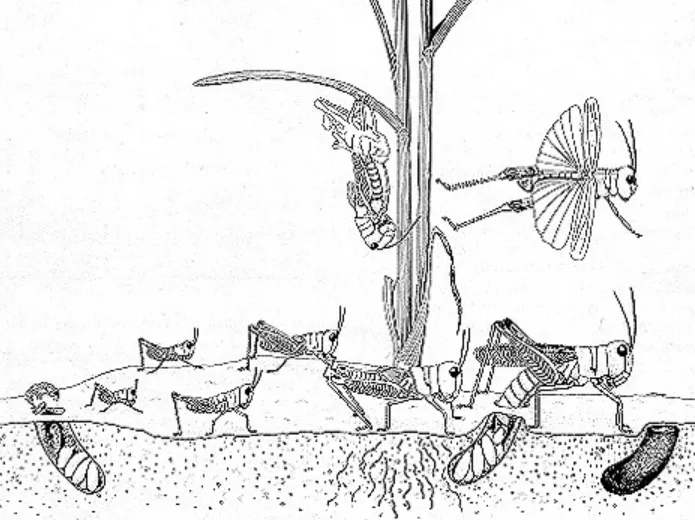
Grasshopper reproduction is simple, seasonal, and highly adapted to life in open habitats. Adult males and females are usually ready to reproduce after completing the nymphal stage. Males often locate females through movement, sound, or close-range signals depending on the species.
Key points in the reproductive process:
- Mating occurs after adulthood: Grasshoppers reproduce only after reaching adulthood.
- Females lay eggs in soil: After mating, the female uses her abdomen to deposit eggs into the ground.
- Eggs are protected in pods: Many species surround eggs with a sticky or foamy material that hardens into a protective pod.
- Egg number varies by species: Some sources report females may lay multiple egg pods, with egg numbers differing widely by species. Nebraska Extension notes that a female may lay about 100 eggs during summer and fall, although the exact number depends on species and conditions.
- No parental care after egg-laying: Grasshoppers do not care for their young as birds or mammals do.
- Nymphs survive independently: After hatching, nymphs must find food, avoid predators, and molt successfully.
The phrase “raising their children” is different for grasshoppers than for animals with parental care. A female grasshopper protects her offspring mainly by choosing a good egg-laying site and placing eggs in soil. The egg pod acts like a natural nursery. Once the nymphs hatch, they are independent.
This strategy works because grasshoppers produce many eggs. Even if many eggs or nymphs are eaten, dried out, drowned, or infected by disease, enough may survive to continue the population.
The importance of them in this Ecosystem
A major food source for wildlife
Grasshoppers are important food for many animals. Birds, frogs, snakes, spiders, small mammals, robber flies, and other predators feed on them. Britannica describes grasshoppers as important members of the food web, and Colorado State University Extension also notes several natural enemies, including birds, blister beetles, robber flies, fungi, and nematodes.
Because grasshoppers are rich in protein, they support the growth and survival of many insect-eating animals.
Plant biomass consumers
Grasshoppers help transfer plant energy into animal food chains. They eat grasses, weeds, leaves, and crop plants, then become food for predators. This makes them a bridge between plants and higher animals.
Natural selection and biodiversity
Grasshoppers are part of the natural ecological balance. Predators, parasites, disease, rainfall, temperature, and food availability control their populations. This interaction supports biodiversity.
Soil and nutrient cycling
When grasshoppers die, their bodies return nutrients to the soil. Their feeding can also influence plant growth patterns. In balanced numbers, they are part of the natural nutrient cycle.
Agricultural warning indicators
Large grasshopper populations can signal habitat imbalance, drought stress, or reduced predator activity to farmers and land managers. In this way, they can serve as ecological signals.
What to do to protect them in nature and save the system for the future
Protecting grasshoppers does not mean allowing harmful outbreaks in farms. It means maintaining a balanced ecosystem where grasshoppers, plants, predators, and soil life can exist together.
- Protect natural grasslands: Grasslands are important habitats for many grasshopper species and their predators.
- Avoid unnecessary pesticide use: Broad pesticide use can kill grasshoppers, bees, butterflies, beetles, spiders, and natural enemies.
- Encourage natural predators: Birds, spiders, frogs, robber flies, and beneficial beetles help keep grasshopper populations balanced.
- Maintain plant diversity: A mix of grasses, wildflowers, shrubs, and native plants supports healthier insect communities.
- Avoid destroying all field edges: Some field margins provide habitat for insects and predators, but they should be managed carefully near crops.
- Use integrated pest management: When grasshoppers become crop pests, use monitoring, habitat management, biological control, and targeted treatments rather than random spraying.
- Protect soil health: Since many grasshoppers lay eggs in soil, healthy soil supports natural life cycles.
- Reduce habitat pollution: Chemical runoff, plastic waste, and soil contamination can harm insects and the animals that eat them.
- Support native species: Native grasshoppers are part of local food webs and should not be confused with every crop-damaging outbreak.
- Educate children and farmers: Better knowledge of the grasshopper life cycle helps people manage them wisely rather than fear them unnecessarily.
Frequently Asked Questions (FAQs)
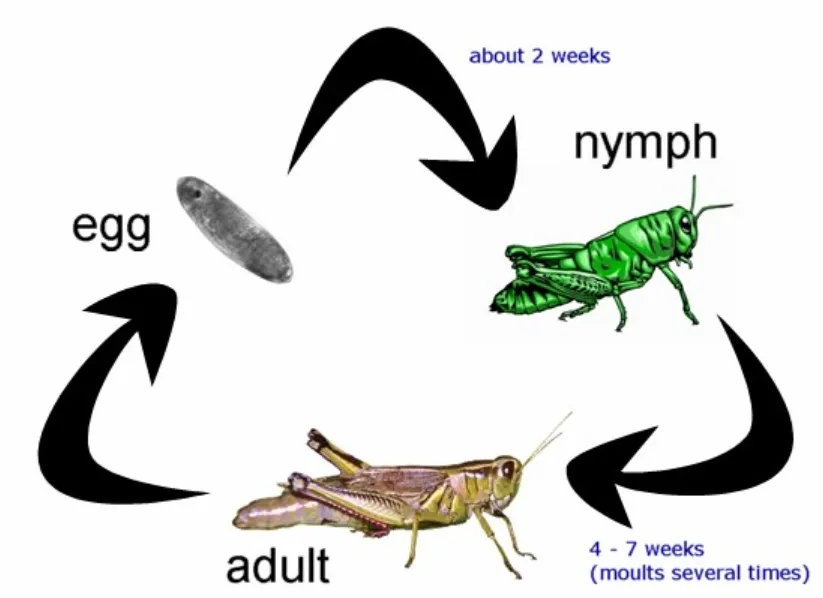
Q: What is the grasshopper life cycle?
A: The grasshopper life cycle has three stages: egg, nymph, and adult. This is called incomplete metamorphosis because there is no pupal stage.
Q: How long does it take for a grasshopper to become an adult?
A: The time varies by species, temperature, and food availability. In many species, nymphs pass through several molts before becoming adults.
Q: What is a grasshopper nymph?
A: A grasshopper nymph is the early stage that hatches from the egg. It looks like a small adult but does not have fully developed wings.
Q: Do grasshoppers have a pupa stage?
A: No. Grasshoppers do not have a pupa stage. They grow through incomplete metamorphosis, unlike butterflies and beetles.
Q: Where do grasshoppers lay eggs?
A: Female grasshoppers usually lay eggs in the soil, often in protected pods. Many species lay eggs in late summer or fall.
Q: What do grasshoppers eat?
A: Most grasshoppers eat plants, especially grasses, leaves, weeds, and sometimes crops. However, only some species become serious crop pests.
Q: Are grasshoppers useful or harmful?
A: Grasshoppers are both useful and harmful. They are useful because they feed wildlife and support food webs. They can be harmful when large numbers damage crops.
Q: What animals eat grasshoppers?
A: Birds, frogs, snakes, spiders, robber flies, small mammals, and other predators eat grasshoppers. They are an important part of natural food chains.
Conclusion
The grasshopper life cycle is a powerful example of nature’s simple but successful design. From hidden grasshopper eggs in the soil to active grasshopper nymphs and strong jumping adults, every stage has a clear purpose. Eggs protect the next generation, nymphs grow through molting, and adults reproduce to continue the cycle.
Grasshoppers are not just crop-feeding insects. They are part of a much larger ecological system. They eat plants, support predators, recycle nutrients, and help connect plant life with animal life. At the same time, some species can become pests when weather, drought, and habitat conditions favor rapid population growth.
The best way to understand grasshoppers is through balance. Protect their natural role, encourage predators, avoid unnecessary chemicals, and use smart management when needed. By learning the grasshopper life cycle, we can better protect nature, agriculture, and the Ecosystem for the future.
Also Read: sunflower life cycle